

AI has accelerated the demand for energy in ways we’ve never seen before and taking by surprise all the predictions and roadmaps with its timing and magnitude.
However, AI is not the sole trigger of data center growth and increasing power consumption. The power crisis is a dormant broader issue that encompasses societal trends and growing digital dependence, from more data storage to faster and more powerful compute needs. The energy systems, including the grid, need modernization and diversification, cross-industry collaboration, and further standardization to meet all of these challenges.
At this point in time there are several possible alternatives to face the energy situation, both renewable and non-renewable, when it comes to more energy-efficient and easy-on-the-grid means of powering data centers, which are critical to the world’s power infrastructure.
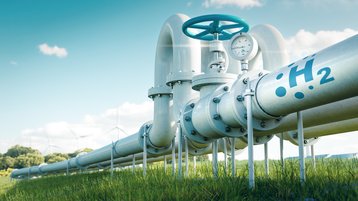
Hydrogen – holy grail or high-maintenance?
Data centers need massive amounts of stable and high-quality energy with the lowest possible carbon footprint. One could dream of using hydrogen as a fuel that combines with oxygen in “fuel cells” to produce electricity and emit only water and heat, which are valuable byproducts. This would be a wonderful solution if a huge amount of hydrogen could be produced with a very low carbon footprint.
Currently, most hydrogen is produced using fossil fuel energy at a fraction of the cost of hydrogen that relies on emissions-free power. Recently, more virtuous ways of producing hydrogen have been envisioned - extracting hydrogen from water molecules by powering electrolyzers with solar or wind-generated electricity or cracking water molecules at ultra-high temperature as a byproduct in some specific nuclear reactor types.
Hydrogen is not a primary energy but rather an energy vector, like electricity. However, hydrogen can be quite easily stored in tanks, which is much more difficult and costly for electricity. And this is a huge value proposition for powering data centers. Adopting hydrogen power in data centers is still in its early stages but shows great promise through efforts like Microsoft’s Green Hydrogen Initiative.
Overcoming challenges
Benefiting from huge hydrogen energy storage systems does come with some challenges to overcome.
Hydrogen has the highest energy content per unit mass, making it an excellent fuel in terms of weight. However, because it is a very light gas, it has the lowest energy content per unit volume. This means that storing and transporting hydrogen can be challenging, as it requires high pressures or cryogenic temperatures to be stored in a compact form.
Compressing hydrogen to 700 bar, for example, will consume 10 to 15 percent of the energy content. Then generating electricity from hydrogen in a fuel cell has a typical efficiency of 40 to 60 percent (still much better than the around 35 percent traditional combustion-based power generation). Considering that generating hydrogen by electrolysis has an average efficiency of 60 to 80 percent, the overall round-trip efficiency is approximately only 20 to 45 percent. But the devil is in the details.
Hydrogen atoms are so small that they can permeate solid metals. Once absorbed, hydrogen reduces the stress required for cracks to initiate and propagate which can weaken storage systems. This means that all the piping and plumbing must comply to extremely stringent standards. Significant investments in infrastructure are needed to produce, store, and distribute hydrogen safely.
And, for safety reasons, large hydrogen storage solutions must be installed at a safe distance from populated areas, buildings, and other critical infrastructure… like data centers.
In the US, the ordered immediate suspension of funding under the Inflation Reduction Act (IRA) and the Infrastructure Investment and Jobs Act (IIJA) will have a significant impact on US hydrogen production. Cancelling extensive subsidies, like the $7 billion earmarked for seven regional clean hydrogen hubs and potential hydrogen production tax credits up to $3 per kg under the IRA, will dramatically freeze current promising progress.
But the most painful piece for players in the sector is the potential cancellation of projects already committed with the Department of Energy, which has already allocated more than $170bn in grants and loans, and the Environmental Protection Agency, which has already distributed 93 percent of its IRA grant funding.
Nuclear – stable, carbon-free energy source
Nuclear power offers a stable and dependable energy supply, unlike wind and solar power, which are intermittent and dependent on weather conditions. In fact, nuclear energy provides massive and stable thermal energy to power rotating electricity generation machines. Their significant mechanical inertia provides a major contribution to stabilizing the entire electric system (balancing active and reactive power).
While renewable energy sources like wind and solar are unquestionably integral to a sustainable future, their variability is posing challenges to massive deployments. The stability of the electric system must cope increasingly with the virtual simulated balancing inertia of their power electronics. In fact, according to IEA, many renewables projects are unfortunately waiting to be allowed to connect to the global grid. At the end of 2023, over 3000GW of renewable generation capacity were in ‘grid connection queues’ despite many projects being already in advanced stages of development.
This situation is a challenge taken up by international standardization. Progress is being made to make more dispatchable renewable energy. Some Smart String Grid Forming multi-energy renewable and storage systems have already been successfully demonstrated at utility scale.
IEC Standards and Conformity Assessment, for example, are building blocks under development to architect strong and dependable smart grids. However, for the time being, even with smart grids, the booming power needs of data centers cannot wait, and make nuclear power a highly valuable complement.
Additionally, nuclear energy is a carbon-free source, aligning with global efforts to reduce carbon emissions and combat climate change. Progress is also ongoing in terms of nuclear safety and nuclear waste management.
This explains why nuclear energy is (re)considered in many energy transition roadmaps around the world. The advent of Small Nuclear Reactors (SMR) and Advanced Modular Reactors (AMR) is also opening up many new options thanks to their smaller size, prefabrication of building blocks, industrial-grade supply chain, and lower cost.
Battery Energy Storage Systems (BESS): An old dream or ideal destination
Battery Energy Storage Systems has been considered for a long time as an ultimate destination. The journey is still ongoing, benefiting from the acceleration of the development of Electric Transportation. Direct storage of electricity could also suddenly benefit from the new disruptive advent of electrochemical innovations under very active exploration.
Part of what makes BESS attractive for data centers is the increased flexibility and stability it can offer if leveraged well. They can help provide backup power during outages and contribute to grid stability in case of frequency and voltage variations, according to my colleague, Howard Porter, IEC Market Strategy Board Member, and energy-efficiency expert.
In 2023, IEC published a Technical Specification (IEC TS 62786-3:2023), which covers comprehensive principles and technical requirements for the interconnection of distributed BESS to distribution networks. This Technical Specification is pivotal for the design, operation, and testing of BESS, ensuring they meet the necessary requirements for grid integration.
The technical guidelines it specifies will also be crucial in ensuring safe, efficient ways of integrating BESS for various applications.
IEC is currently also working on a new Standard IEC 62933 that applies to the effects of the environmental conditions on Battery Energy Storage Systems (BESS). Typical environmental effects on the BESS include, but are not limited to, the effects of lightning, seismic activities, water, air, flora, fauna, and humans. The idea is that, based on those effects, preventative or mitigating measures will be described in this standard.
Overall, there is great promise, and necessity is the mother of invention. But, policy shifts create uncertainty in the clean energy market, which will slow down R&D and potentially deter private investment in new projects.
The energy challenges presented by AI are driving innovation across the entire energy and data center ecosystem. The real potential lies in the integration of renewable and non-renewable options to create a balanced energy infrastructure and the implementation of technical standards that ensure a sustainable market of solutions.



Comments