
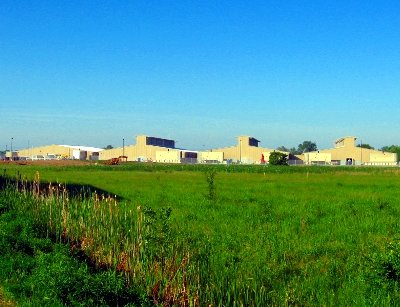

Monday was the official launch date for first phase of the new Yahoo! data center in Lockport, New York. This is a fifth-generation data center design for the company and most energy efficient one, according to Yahoo! Head of Global Data Center Operations Scott Noteboom.
The facility’s annualized average PUE is 1.08, achieved through a number of design features, including lots of free cooling, an evaporative-cooling system, omission of chillers and air handlers, a ceiling for air temperature and humidity that exceeds ASHRAE guidelines, hot-aisle containment and other elements.
"We are currently on our fifth generation of design," Noteboom said. "There is a huge opportunity to gain efficiency, cost-to-build and speed-to-build" with every new design.
The building is famous for its design that resembles a chicken coop. The design allows a maximum amount of outside air to end up inside an air plenum inside the data center, where it is mixed to appropriate temperature and humidity with warm return air from the data center floor before being delivered to the IT equipment.
The building was positioned to leverage winds from the nearby Great Lakes, which in combination with the collective power of server fans and a few fans for air re-direction made air handlers unnecessary. When outside air is too warm, the adiabatic-cooling system kicks in, which, according to Noteboom, is only used about 200 hours per year on average.
Noteboom’s team was able to raise the allowed air temperature and humidity levels above ASHRAE guidelines but stay within the OEM-specified envelope after spending about four years of studying the subject.
The data center is using a flywheel-based energy storage system.
The first phase provides 9MW of power and the second phase, under construction since June, will be of comparable capacity. Yahoo! expects to complete the second phase in December. While the first phase included data center halls and an administrative building, the second phase will only include data center space, which will be on the opposite side of the phase-one data center.
In June of 2009, Yahoo! made a commitment to reduce its overall carbon emissions by 40 percent by 2014 and increasing energy efficiency of its data centers is key in reaching that target.