
Satellite firm Xona Space Systems has declared $92 million in new funding for its new fleet of positioning satellites.
The funding, which includes its Series B round led by Craft Ventures alongside participation of existing investors, will fuel the company's aims to launch Pulsar, a low-Earth orbit (LEO) constellation aiming to deliver precision position, navigation, and timing (PNT) services.
“Pulsar solves the growing limitations of legacy GNSS with improved reception in urban canyons, under tree covers, and indoors with centimeter-level precision critical for precision agriculture, robotics, and augmented reality,” a Xona Space spokesperson told DCD.
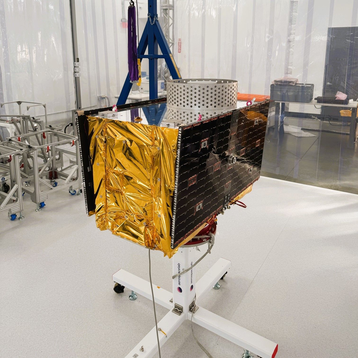
Xona has since launched Pulsar-0, the first production-class satellite of its eponymous constellation, intended to serve industries like construction, agriculture, mining, critical infrastructure, mass mobile, logistics, automotive, and even defense.
California-based Xona is a space startup looking to disrupt the satellite navigation field. The new injection of capital brings the company to a total of $150 million in total funding, fueling its journey toward delivering hundreds of satellites into orbit in a matter of years.
The company touts a hundred-fold stronger signal strength compared to geostationary alternatives, as well as more secure connections resilient to spoofing and interference. Assumptions around demand for centimeter precision satellite positioning may prove to be bold, given the longstanding suitability of geosynchronous PNT across many industries.
“American farmers today must resort to stronger signals from Russian and Chinese satellites,” explained Taylor Durand, an investor at Craft Ventures.
Sky Dayton at Craft Ventures will join Xona’s board as part of the new funding. The firm joins existing investors Stellar Ventures, Seraphim Ventures, Toyota Ventures, First Spark, Industrious Ventures, Future Ventures, and NGP Capital.
Xona first proved its mettle in low-Earth orbit PNT after launching its Huginn demonstrator satellite in 2022, which has informed cost savings that have gone into developing the Pulsar constellation.
The first production-class satellite in the Pulsar constellation was launched last week.
“Today’s technologies need something new – infrastructure that is more accurate, more resilient, and more responsive to change,” Adrien Perkins, Xona Space co-founder and vice-president of engineering, wrote in a blog post. “With Pulsar-0 launching, we are taking the next step towards that future.”




Comments