
A $700 million subsea and terrestrial data cable is planned to connect Europe and the Middle East.
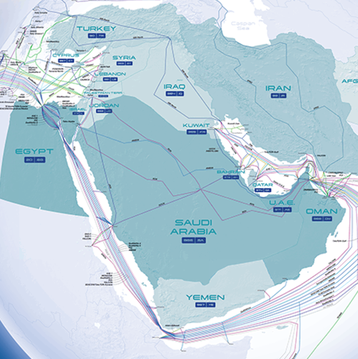
Named ‘WorldLink,’ the cable plans to deliver 900Tbps (terabits per second) of capacity and run between the United Arab Emirates (UAE) and Turkey through Iraq.
Construction is aimed take place in phases over five years, with the project privately funded and built by a UAE-Iraqi consortium backed by regional firms: Iraqi companies Tech 964 and DIL Technology, and the Emirati-based Breeze Investments.
“AI infrastructure readiness is a necessity as we witness its adoption worldwide,” Breeze chairman Nayef Al Ameri told Reuters. “WorldLink is designed to deliver the fastest and most reliable connectivity in the region serving these needs.”
Breeze Investment’s backing of the project is its second in as many years, following its investment in another cable scheme connecting the Gulf with Iraq in September 2025.
WorldLink will begin in Abu Dhabi, with branches connecting Qatar, Bahrain, Saudi Arabia, and Kuwait. Its main trunk will cross the Persian Gulf and land at Al Faw, a port on Iraq’s southern coast, before proceeding overland to Turkey.
The cable will be carrier-neutral, the consortium said in a separate announcement, and will be designed specifically for use by international carriers, hyperscalers, and those firms pursuing AI-driven applications.
Its 900Tbps capacity, it added, is intended to reduce latency between users in Europe and the Middle East to below 100 milliseconds, thereby aiding applications such as financial trading and AI inference. Its placement in Iraq and Turkey will also bypass an increasingly crowded market for submarine cables running along Egypt’s Suez Canal, which has proven increasingly vulnerable to sabotage.
WorldLink’s announcement comes amid an investment surge in the region’s digital infrastructure sector and a growing geopolitical rivalry between the UAE and Saudi Arabia.
Last week, Saudi Arabia-backed telco STC Group won an $800 million contract to build a new 4,500 km (2,796-mile) fiber-optic cable network in Syria. Known as ‘SilkLink,’ the project is one of the country’s first major inflows of foreign investment into its telecoms network, which was partially destroyed during its 15-year civil war.
Shortly beforehand, Syria’s communications minister had also praised the UAE as a key partner in the former’s transformation, stating that the two countries had recently held several meetings to discuss future partnership opportunities.
Learn more about the data center market in Saudi Arabia and meet with other executives and experts in the region at the DCN Riyadh event next year.





Comments