
Vodafone has teamed with researchers at the University of Málaga to develop photonic chips capable of sending a signal straight to a user’s smartphone using light.
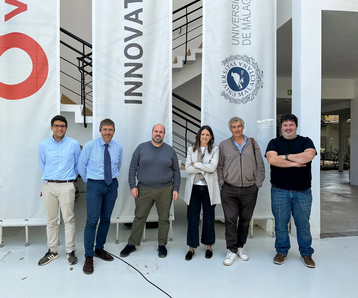
The project sees the telco giant partner with the university’s Photonics and Radiofrequency Research Lab to develop hardware that uses optical beamforming to fire mobile traffic to a device with pinpoint accuracy.
Unlike traditional electronic and radio frequency-based methods, which rely on phased antenna arrays and electronic phase shifters to direct radio signals, optical beamforming uses light to steer signals.
Its narrower beams have the potential to deliver data rates across higher frequency bands, minimizing spillover and crosstalk with adjacent users or frequencies.
“While some mobile masts are already equipped with beamforming technology to direct a signal toward a specific area instead of broadcasting it more broadly, the incorporation of photonics provides a significant advantage,” Vodafone said in a statement. “It will provide a greater degree of accuracy, reducing signal loss and limiting interference from other frequencies.”
Vodafone, along with the Spanish research team, is attempting to create prototype silicon-based chips that use light instead of electricity to power next-generation 5G-Advanced and eventual 6G network workloads.
The partners plan to put together two prototypes – one that involves a passive chip as a proof-of-concept, and a second designed to replace the current beamforming component within a radio unit.
Alongside prototypes, the pair plan to put together a blueprint for photonic radio unit chips for mobile base stations within the next two years that would be used to show customers the technology can be used to support continuous streaming services without buffering.
The telco said its ultimate goal is to develop an improved optical radio unit where most of the electrical elements will be replaced by optical ones, though such an undertaking will “require more time.”
The photonics project is being supported by the European Commission’s Important Projects of Common European Interest (IPCEI) Program and the Spanish Ministry of Industry and Tourism.
Beyond mobile, the telco giant said optical beamforming technology will also help to reduce latency for advanced radar and direct-to-device satellite communication systems.
Vodafone is working with a separate team of researchers at the University of Málaga, along with AST SpaceMobile, to develop low Earth orbit space-based mobile broadband services.
Unveiled back in February, the project will see the telco and university set up a hub to design and test new open-source hardware, software, and processing chips capable of operating in both space and terrestrial networks.






Comments