
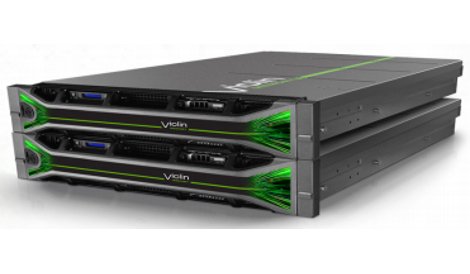

Violin Memory, Santa Clara, California-based flash storage vendor, launched a new software and appliance Thursday, it says will give the benefit of flash storage performance to legacy non-flash storage infrastructure.
For Violin, the solution is a way to convince enterprises that benefits of memory-based storage are worth making the investment in transitioning to all-memory storage environments, especially ones built by Violin itself.
Ashish Gupta, director of product marketing at Violin, said the Maestro Memory Services Software Suite and the Memory Services appliance the software runs on, were designed to integrate automatically and seamlessly with any legacy storage fabric. Once installed, Maestro analyzes traffic moving to and from the storage infrastructure, identifies stored data accessed most frequently and stores it in the memory-based appliance for quicker access, making the appliance the high-performance memory tier.
The solution aims to provide this performance improvement as non-invasively and seamlessly as possible. “We essentially support any legacy infrastructure,” Gupta said. “It doesn't matter.”
Two eight-terabyte appliances can handle a 100TB legacy storage infrastructure, he said. If more capacity is required, a user can bring in a memory array.
For now, Maestro only supports Violin's own memory arrays, but the company does have plans to add support for other flash-array vendors' products in the future, Gupta said.
Street price of the appliance, loaded with the software, is about US$180,000. This package will include acceleration and tiering functionality.
Maestro also has data migration and protection capabilities, which are not included in that price. Pricing for these services, structured as software licenses, will vary from customer to customer, depending on the capacity of their storage environment.
While there are plenty of other vendors offering storage tiering, Gupta said Maestro did tiering much faster than the competitive solutions did. “In the case of Maestro, we're talking minutes,” he said, as opposed to “hours” competing products take.
The main purpose of the release is to allow customers to experience the benefits of memory and set out transition paths from disk-based storage over to memory-based storage fabrics, Gupta said.