
The US Department of State has led the formation of ‘Pax Silica,’ an international effort to develop a secure supply chain for semiconductors.
The initial group includes South Korea, Japan, Singapore, the Netherlands, the United Kingdom, Israel, the United Arab Emirates (UAE), and Australia.
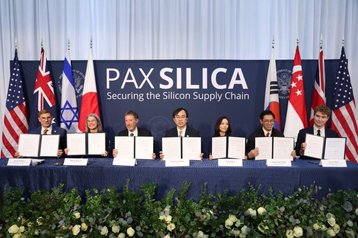
Pax is Latin for 'peace,' most notably used to denote Pax Romana, a 200-year period of relative peace in the Roman Empire. The period after WWII has been referred to by some as Pax Americana.
"If the 20th century ran on oil and steel, the 21st century runs on compute and the minerals that feed it," the Under Secretary for Economic Affairs, Jacob Helberg, said.
"This historic declaration hails a new economic security consensus ensuring aligned partners build the AI ecosystem of tomorrow – from energy and critical minerals to high-end manufacturing and models."
The project was launched during a pre-event at the newly rebranded ‘Donald J. Trump Institute of Peace,' followed by a larger summit.
Summit participant countries said that they would explore opportunities to partner on flagship projects across global technology stacks, including connectivity and data infrastructure, compute and semiconductors, advanced manufacturing, logistics, mineral refining and processing, and energy.
The move comes amid growing tensions with China, with the US restricting chip sales to the country and China restricting critical rare earth minerals from export. Several of those minerals are key to semiconductor development.
Not included in the new group is Taiwan, home to as much as 60 percent of the world's chip manufacturing and around 90 percent of the highest-end chips. This is primarily through foundry leader TSMC, but also UMC, MediaTek, and an entire ecosystem of companies.
However, China claims that Taiwan is not a country and is simply a rebellious province. The US retains strong relations with Taiwan, but does not officially recognize it as a country as part of its One China policy.
US President Donald Trump last year claimed that Taiwan stole America's chip business and said that the country should pay for protection.



Comments