
Outages are becoming less frequent and severe but more expensive.
This is according to a new report about global outages in 2024 published by Uptime Intelligence, a research subscription service. It operates under Uptime Institute, an advisory business focused on IT infrastructure.
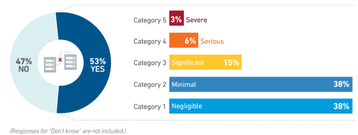
53 percent of operators reported an outage from 2021 to 2024, a lower proportion than in the previous three-year periods.
The severity of outages has also declined. Moreover, out of Uptime Intelligence’s five categories of outages, 76 percent of 768 operators surveyed said that they only experienced ‘minimal’ or ‘negligible’ outages. The remaining 24 percent of operators experienced outages that were ‘significant’, ‘serious’, or ‘severe’, with three percent being ‘severe’.
Uptime ascribed this to “industry progress in risk management and reliability,” which has occurred in lockstep with the growth of the industry as a whole.
However, outages that do occur are becoming more expensive. Of 91 operators surveyed, 54 percent of respondents said that their most recent significant outage exceeded $100,000 in total costs. 20 percent of outages cost more than $1m, a four percent year-on-year (YoY) increase.
Uptime Institute attributes this to the increasingly critical nature of digital services, inflation, rising labor and hardware replacement costs, service level agreement penalties, and longer recovery times.
Power-related issues continue to be the leading cause of impactful outages. Out of 97 operators surveyed, 54 percent primarily attributed their woes to power. The runner-up, cooling, only garnered 13 percent, and third place was network-related issues at 12 percent.
But out of 412 operators who were asked about the most common cause of outages irrespective of severity, IT and networking constituted 53 percent of all answers. Uptime Institute attributes this to “increased IT and network complexity, leading to issues with change management and misconfigurations.”
Human error is becoming a greater concern. This is treated by the report as a contributing factor rather than a root cause of outages and is therefore analyzed on its own. Amongst 397 surveyed operators, 58 percent said that within the category of human error, most issues were due to data center staff failing to follow procedure, reflecting the nascent nature of talent tapped to fill the growing demand in the industry. This is a 10 percent YoY increase.
The report also comments on the expanding usage of “software-based and distributed resiliency tools,” which complement existing redundancy precautions. But the shift to software has also made it more difficult to classify and analyze the root cause of an outage.
“Outages overall have slowed down,” said executive director of Uptime Intelligence Andy Lawrence. “Data center operators are facing a growing number of external risks beyond their control, including power grid constraints, extreme weather, network provider failures, and third-party software issues. And despite a more volatile risk landscape, improvements are occurring.”






Comments