
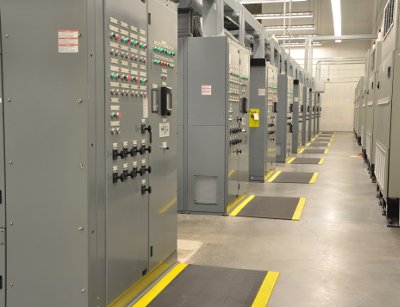

“Concurrent maintainability” is a huge concept in the data center world. It means being able to do maintenance on a piece of equipment within your infrastructure while that infrastructure keeps humming along without interruption.
There are standardized methods to get concurrent maintainability, usually by hooking up redundant infrastructure components that fill in for each other during maintenance. Some data center operators, however, come up with their own methods to add extra layers of reliability to their facilities.
One of these latter operators is RagingWire, a Sacramento, California-based data center services provider that uses an unconventional method for bypassing Uninterruptible Power Supplies (UPS) that back up critical load for maintenance without interrupting electricity flow to the critical load. In July, the US Patent and Trademark Office issued a group of three engineers working for RagingWire a patent on the invention.
The primary inventor was Charles Linkhart, the company’s chief engineer, who works out of its Sacramento data center. We caught up with Linkhart in October, when RagingWire announced the patent, to learn what exactly he had invented.
“We were looking for a method to be able to do complete maintenance on the UPS without affecting the load at all,” Linkhart says. In the nutshell, the idea is to add an alternate energy source (in addition to the conventional generators and UPS) and an extra breaker to the circuit, and to come up with a sequence of operations to have that extra energy source power the critical load while the UPS is taken off line without interruptions.
How it works
The energy source is added to the maintenance bypass, a power path parallel to the UPS that is traditionally activated for UPS maintenance. In the traditional scenario, however, the critical load is connected directly to the utility or generator feed. If this feed is interrupted during a UPS maintenance window, the critical load is lost. If something goes wrong with the UPS during the maintenance window, it can affect critical load as well. Linkhart’s approach both ensures critical load is not dependent solely on the utility feed during UPS maintenance and isolates the UPS from the circuit while it is being worked on.
Here is how it works. The alternate power source is connected, with its own breaker, between the two breakers on the traditional maintenance bypass. If the UPS needs to be worked on, this power source is energized and utility power is turned off. At this point, critical load is running on power drawn from the UPS battery, since the breaker between the alternate source and the bypass is open. Power is then directed from the alternate source to the UPS input, and the UPS-battery discharge stops.
At this point, the UPS is transferred from inverter to its internal bypass, which means its input is connected directly to its output, without sending power through a rectifier and an inverter. The critical load is now getting its power from the alternate source without having gone through any interruptions. The next step is to close an external bypass-circuit breaker to have power from the alternate source feed the critical load via two parallel paths.
In this state, the UPS output is disconnected from the critical load and UPS input is disconnected from the alternate power source, while utility power to the UPS is restored so it can be tested at full load coming from its normal source. This way, even it if it fails during testing, there are no interruptions to the critical load.
To return to the normal mode of operation, the steps are followed in reverse. The sequence, either to take the UPS off line for maintenance or to bring it back online, is not done manually. The system includes a programmable logic controller (PLC), programmed to open and close breakers using the correct sequence.
In most recent designs, RagingWire uses a spare UPS as part of the alternate power source, adding an extra layer of protection to the critical load. “This spare UPS allows us to completely remove an on-line UPS from service and still suffer a complete failure of another unit without losing power to critical load,” Linkhart says. “We have left a UPS on this redundant bypass source for nearly a week while the unit underwent a major repair, all without any disruption in power to the customers served by the downed unit.”
All three RagingWire data centers (two in Sacramento and one in Ashburn, Virginia) have the system installed. It was initially installed in Phases I and II in Sacramento in 2006, he says. The phases had been running for six years without it prior.
What keeps you awake at night?
Linkhart says he came up with the idea in the middle of the night in 2006. “Most of my good ideas come at three o’clock in the morning,” he says. At that point, he had been consulting RagingWire since 2000. In July 2007 he became a direct employee. He had worked for an electrical consulting firm in Sacramento for 17 years prior to becoming chief engineer at the data center company. Prior to consulting, he spent another 17 years working at a nuclear power plant operated by the Sacramento Municipal Utility District.