
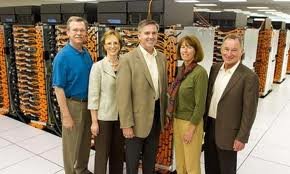

The latest supercomputer Top500 list was issued yesterday with IBM at top spot with a 96-rack Blue Gene/Q system clocking in at 16.32 sustained petaflops (quadrillion floating point operations per second).
The system is used by the US National Nuclear Security Administration (NNSA) at the Lawrence Livermore National Laboratory (LLNL) to manage the storage of and testing of the US nuclear arms stockpile.
Sequoia is primarily water cooled and consists of 96 racks; 98,304 compute nodes; 1.6 million cores consisting of eight of 16 core systems based on IBM’s own ‘Power’ processing architecture ; and 1.6 petabytes of memory.
Intel pointed out that the majority of the Top500 installations run on Xeon and that includes Europe’s most powerful supercomputer at LRZ which uses 18,000 Xeon cores.
Component specialist technology site Techeye reported that AMD issued a statement headlined: “AMD supercomputing leadership continues with broader developer ecosystem and latest top 500”. It keenly pointed out that 24 of the top 100 are powered by AMD, though Intel was pleased to announce its architecture powered 74 percent of all systems, and 77 percent of all new entries.”
TheTop500 is compiled using the Linpack Method –
“The LINPACK Benchmarks are a measure of a system’s floating point computing power. Introduced by Jack Dongarra, they measure how fast a computer solves a dense n by n system of linear equations Ax = b, which is a common task in engineering.
The aim is to approximate how fast a computer will perform when solving real problems. It is a simplification, since no single number can reflect the overall performance of a computer system.
Source: WikiPedia.