
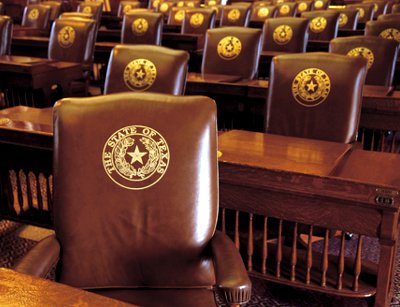

One thing Texas legislators do not like is being behind other states in something. A group pushing for the state to pass a set of tax breaks for data center owners and users is using the lawmakers’ Texas pride to convince them that the bill needs to pass.
Brad Enloe, principal at Capstar Real Estate Advisors, is one of the people lobbying state government for the new tax law. “We talk about how the State of Texas used to be a leader in technology, all the way back to Texas Instruments days, way back when,” he said in an interview at the DatacenterDynamics Converged conference in Dallas in December, referring to the gigantic Texas semiconductor manufacturer that has been around since the early 1950s. “That’s really dried up.”
Enloe and his partners mention massive data center projects that have gone to other states because they offer tax incentive packages, trying to paint a picture for legislators of a Texas that is missing economic-development opportunities because of its outdated tax code. “They don’t like the fact that we’re falling behind in something,” Enloe said.
Bill to be introduced in January
And the approach seems to be working. Enloe expects a data center tax-break bill to be introduced in the state house of representatives in January, sponsored by Representative Harvey Hilderbran, chairman of the Ways and Means Committee, a key house body for tax-related issues.
John Patterson, also a principal at Capstar, says there are several opportunities to attract major data center builds to Texas right now.
“We believe we’ll have … three major data center relocations in the next four years of the magnitude you’ve seen in North Carolina, Iowa, Nebraska,” Patterson said. “We know specifically there is a large user who was not considering Texas, but they heard about the bill, and they’re now considering Texas on their shortlist.”
Among North Carolina’s recent data center wins are large projects by Facebook, Apple, Disney, Time Warner Cable, AT&T and NetApp. The state enacted tax incentives for new data center projects in 2009.
Iowa offers data center tax incentives, and Google and Microsoft have built data centers there.
Nebraska governor Dave Heineman signed a data center tax-break bill into law in March. In October, Fidelity Investments announced a plan to build a US$200m data center in the state, and there have been reports of another large user who has Nebraska on its short list for a major data center build.
Trophy data center users
Texas already has an active high-tech sector and a robust colocation data center industry. The tax-break legislation is really about attracting some of the household-name icons of the Internet age – the Facebooks and Googles of the world.
“We’re a very good market for smaller users and colocation and managed-services type users,” Enloe said. “But were just not seeing the big trophy users, the big enterprises.”
Capstar, which merged with the large commercial-real-estate-services firm Cassidy Turley in January 2011, owns a massive data center shell building at 3000 Skyline Rd. in Dallas it is trying to lease to a large tenant, so the company has a vested interest in making Texas a more friendly tax environment for data center users.
“Our goal is to get the state on balance [with other states], because we need to lease that building, and we feel like that will be an integral part of getting it leased,” Enloe said.
Second time's the charm
This is not the first time they have tried to push a data center tax bill through in Texas. The house passed a similar bill in 2011, but it died in the senate. Patterson said that happened because the bill was introduced too late in the state’s two-year-long legislative cycle.
This time around, they are starting at the very beginning of the 2013 session and are optimistic the bill will pass. Enloe and Patterson said they had so far seen no opposition to the bill at all.
“The biggest obstacle may be from the part of the community that just opposes corporate welfare,” Enloe said. So far, however, nobody has opposed their bill specifically.