
Satellite firm Telesat is seeking a partner to build out a new wave of ground station infrastructure.
Meanwhile, satellite communications firm Speedcast is reportedly looking to sell off its ground station portfolio as part of a wider breakup of the company.

Telesat seeks ground station build-out partner
Citing people with knowledge of the matter, Bloomberg reports Canadian operator Telesat is seeking bids to expand and manage new ground stations in a deal valued as much as $1 billion.
The Ottawa-based company is working with an adviser to run an auction process to win the right to build the infrastructure for Telesat.
The process is likely to attract interest from infrastructure funds, with the winning bidder gaining the rights to build out the ground network and charge Telesat for using it. The talks are preliminary, however, and Telesat may decide not to go forward with the auction.
Telesat’s existing ground station infrastructure includes owned teleports in Mount Jackson, Virginia; Belo Horizonte, Brazil; and Montreal, Winnipeg, Calgary, and Allan Park, Canada. According to recent earnings results, the company also leases sites in Victoria, Fort McMurray, Hague, Saskatoon, Iqaluit, and St. Johns, Canada; and Middleton, Virginia. The company’s network also includes partner sites in Hawaii, Austria, Australia, and Indonesia.
The company declined to comment to Bloomberg, but the new infrastructure will likely support Telesat’s upcoming Lightspeed low Earth orbit (LEO) satellite network.
Announced in 2016, Lightspeed is due to comprise 198 satellites in polar and inclined orbits, with the launch commencing via SpaceX rockets in 2026 at a 1,000km altitude.
Each satellite will weigh 700 kilos, with Telesat offering up to 7.5Gbps for a single terminal and up to 20Gbps for a single hub location such as a port.
Viasat, Arabsat, and Orange are set to be customers of Lightspeed. A Telesat Lightspeed landing station will be hosted at Orange’s teleport in Bercenay-en-Othe, France.
Speedcast looks to offload ground stations
The news around Telesat follows reports earlier this month that satellite communications provider Speedcast was considering a sale of its ground stations business for more than $1 billion as part of a breakup of the firm.
Again, citing people with knowledge of the matter, Bloomberg reports the company is working with an adviser to look at options for the business.
Founded in 1999 and owned by private investment firm Centerbridge Partners, Speedcast sells satellite communication services. The company serves more than 350 customers in approximately 50 countries and more than 1,100 maritime vessels and offshore rigs. The previously publicly-listed company went bankrupt in 2020 and was acquired the following year by Centerbridge.
The firm is reportedly planning three separate auctions for its services, infrastructure, and government agencies units – though it declined to comment to Bloomberg.
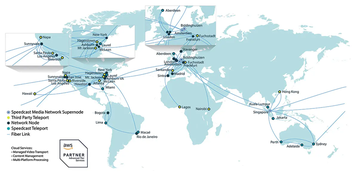
On its website, Speedcast says its network includes 55+ antennae spanning nine meters or greater in size. Its network of 35 owned and partner teleports connects to an integrated fiber optic MPLS backbone spanning 32 points of presence (PoPs), providing uplink and downlink to 95 satellite networks across Ku-, Ka-, and C-bands.
Speedcast owns and operates teleports in Laurel, Maryland; Miami, Florida; Lima, Peru; Macaé, Brazil; Aberdeen, UK; Amsterdam and Biddinghuizen, Netherlands; Kuala Lumpur, Malaysia; Singapore; Jakarta, Indonesia; and Perth, Adelaide, and Sydney, Australia. The company launched a teleport in Cali, Colombia, last year, set to serve Eutelsat’s OneWeb fleet.
While selling off infrastructure assets and leasing them back in part or whole has long been the norm in the terrestrial telecoms industry, such break-ups are traditionally less common in the space sector.
European satellite firm Eutelsat, however, sold its ground station infrastructure to EQT last year in a sale-leaseback deal.
Microsoft recently sold off its ground station infrastructure to Space Leasing International after ending its Azure Orbital ground station service.








Comments