
Canadian satellite giant Telesat has acquired land in Ontario for a new ground station site.
The company has announced the purchase of a plot of land for an undisclosed sum on Laforest Road in the City of Timmins, Ontario, where it intends to build a landing station to serve its LEO satellite network, Telesat Lightspeed, processing orbital data for terrestrial points of presence and the fiber network of Northern Ontario.
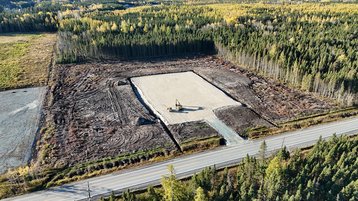
Site preparation is already underway, with crews now clearing the land for the construction of satellite antennas and networking equipment, planned to commence in the Spring of 2026.
“Timmins offers access to superior telecommunications infrastructure, including an extensive 2,200-kilometer (1,367 miles) long-haul fiber network, highly reliable hydroelectric infrastructure, and access to a multitude of energy solutions,” Asit Tandon, chief network and information officer at Telesat, said in a statement. “These features, plus easy accessibility to Southern Ontario and Western Quebec, make Timmins an ideal location to meet the stringent resiliency requirements for our terrestrial Landing Station network. We appreciate the professionalism and responsiveness of [the] Timmins Economic Development [Corporation (TEDC)] throughout our engagement.”
A lightspeed update
Telesat’s Lightspeed constellation, so named for the ubiquity of its optical intersatellite links, intends to enter commercial service in late 2027, with launches to begin in 2026.
The first 198 of the Lightspeed fleet are currently under construction by MDA Space, which began construction on a new manufacturing facility in Quebec in early 2024 to double its manufacturing capacity for Lightspeed.
Optical intersatellite links have since become an industry-standard technology, being the norm for new LEO constellation satellites, including Starlink and Kuiper models.
Telesa switched to MDA Space from Thales Alenia in 2023 and reduced its initial fleet from an original 298 satellite constellation, following supply chain disruption in 2020. Telesat’s latest quarter showed consolidated revenue of $106 million, down 30 percent from the year prior, with the company citing lower rates for North American direct-to-home television customers, LEO revenues being revised lower, and customers reducing some of their services.
Canadian LEO power
LEO constellations like Lightspeed can connect rural communities beyond the effective reach of terrestrial services, with particular utility for remote industry, maritime shipping, and national security applications. Telesat cites Canada’s interests in data sovereignty and the nation’s role in protecting the Arctic.
Timmins city officials strongly welcomed the landing station, stating that the existing infrastructure of the municipality informed the decision.
“Telesat’s decision to establish a Landing Station in Timmins highlights the strategic advantages our city offers — from robust telecommunications to our prime geographic location in Northern Ontario,” Brenda Camirand, director of economic development, City of Timmins, added in a statement. “This project reinforces our commitment to supporting innovative industries and attracting investment that drives economic growth. We look forward to continuing to work with Telesat as [it] advances this exciting initiative, contributing to the growth of our local space economy.”






Comments