
Taara, the Alphabet spin-out developing free space optics, has launched a chip capable of transmitting data at speeds up to 25 gigabits per second (Gb/s).
The aptly named Taara chip shrinks down the core components of a conventional free space optic solution into a piece of hardware about the size of a fingernail. Despite its size, though, the startup claims the chip can take light-based connectivity to the next level.
“It's basically applying silicon photonics with [a] phased array,” Taara CEO Mahesh Krishnaswamy explained to DCD sister publication SDxCentral. “Phased array is available in radio frequency systems, but only up to a certain frequency, [as] doing it in higher frequencies was very difficult.
“We're doing phased arrays with light, which basically means that this is solid state steering, so very few mechanical moving parts, and you can dynamically steer the beam and point it and track it, which increases the dynamic range.”
As a result, the Taara team was able to place the chip into a module – named Taara Beam – with an improved form factor, enabling it to mount on simpler structures like monopoles and rooftops, to boost connectivity pretty much anywhere.
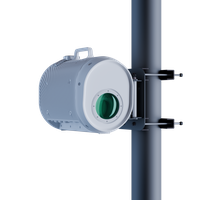
“Effectively, we're making it smaller, faster, and better,” Krishnaswamy said, going as far as to contend that the underlying hardware enables operators to “harness the power of light to remove all the constraints of fiber and radio.”
Each chip featured in Beam features hundreds of tiny light emitters, with an underlying software component controlling when each emits light, in order to manipulate wavefronts and better direct where it needs to go.
Initial tests saw the Taara team able to transmit data at 10 Gb/s across distances of 0.6 miles (1 km) outdoors using just two chips. But the startup has bold plans to boost its range and capacity, potentially creating a future version that houses thousands of emitters.
“So it's only going to get better as we integrate more and more things into it, including lasers as well as other solutions. We'll also try to make this smaller, faster, and more energy efficient,” the CEO said. “What is exciting is that this can now start to get into various different applications, not just communications alone. You can put it into moving platforms. You can probably get it space, with space data centers a huge thing … Or drone to drone.
“As we look forward into the future, the rate-limiting step is going to be our ability to communicate, and we are planning to build products which are in hundreds of gigabits per second.”
From interconnected balloons to breaking data center bottlenecks
Taara didn’t provide too much in the way of technical specs on its small but mighty chip, with Krishnaswamy opting not to reveal the partner manufacturing it. He did, though, stress that the Alphabet spin-out was the one behind the hardware’s design of the chip, and that it has a “substantial amount” of patents and related intellectual property covering the technology.
The design work for Taara’s chip dates back to Krishnaswamy’s early days in X, Google parent Alphabet's moonshot program, working on Project Loon, an effort to bring internet connectivity to remote areas via an aerial wireless network using high-altitude balloons.
“We realized that it was very difficult to solve and keep these balloons afloat, let alone station keep, communicate, and keep it in a very economically feasible way. But somewhere in there was a nugget: the free space optics to communicate from one balloon to the other balloon. And we said, why not just simply bring the technology down to the ground and start connecting people?”
The Taara team would go on to iterate the technology into Lightbridge, which has since been deployed in more than 20 countries with carriers including Airtel, T-Mobile, and SoftBank, before being iterated further in the form of a recently released Pro version.

Alphabet spin out Taara debuts optical switching solution that ‘instantly upgrades’ networks
Launch comes as Airtel, SoftBank, and T-Mobile among carriers using original Lightbridge unit
The startup said the Beam product featuring its chip will be commercially available toward the end of this year, with its CEO bullish on the magnitude of the innovation’s potential: “It is akin to hard drives in the 1950s and 60s that were the size of rooms. Now, we have a solid state card, we can do orders of magnitude higher capacity.”
While Taara debuted the hardware marvel a week before Mobile World Congress to show off its potential to disrupt the telecoms space, the concept could also boost connectivity to another infrastructure realm.
“We have to build data centers at the rate of two per week, and you can do that with digging your way into it and picks and shovels, but you're going to need to get there faster with getting land rights and fiber to all these places is going to take time,” Krishnaswamy said. “We can deliver this, and if they do manage to run fiber, this could remain as a backup or even as a primary.
“One key advantage is when you use this technology over the air, you have nothing but free space. You're transmitting at the speed of light, so your latency is actually lower in many cases than internal reflections that go through a fiber optic cable. So you will be getting one of the lowest latency solutions using this technology, and that's a huge benefit in the AI world.”






Comments