

Tackling big data, high performance computing and the disconnect between facilities and applications is a big task. But construction services firm Skanska has embarked on an ambitious strategy to address just these big questions.
Its first approach is through a water cooling technology developed by Inertech.
The announcement made a splash in the data center community by declaring a mechanical PUE of 1.012 had been achieved in repeated test conditions. And that these types of results or figures close to them could be achieved anywhere in the world - from the North Pole to the Persian Gulf - at variable load. The question of airhandlers coping with high density, high performance and variable loads is over, the company said.
In essence, this is the position taken by Jakob Carnemark, senior VP at Skanska.
Carnemark believes the problems of data center operations are that the facilities infrastructure has created the barrier to efficient, responsive cooling.
If you take a step and look back, every system [recently developed to cool data centers running unpredictable IT loads] is either a chiller derivative or an air side derivative, he says. Blowing air through a data center is not the answer to future cooling requirements.
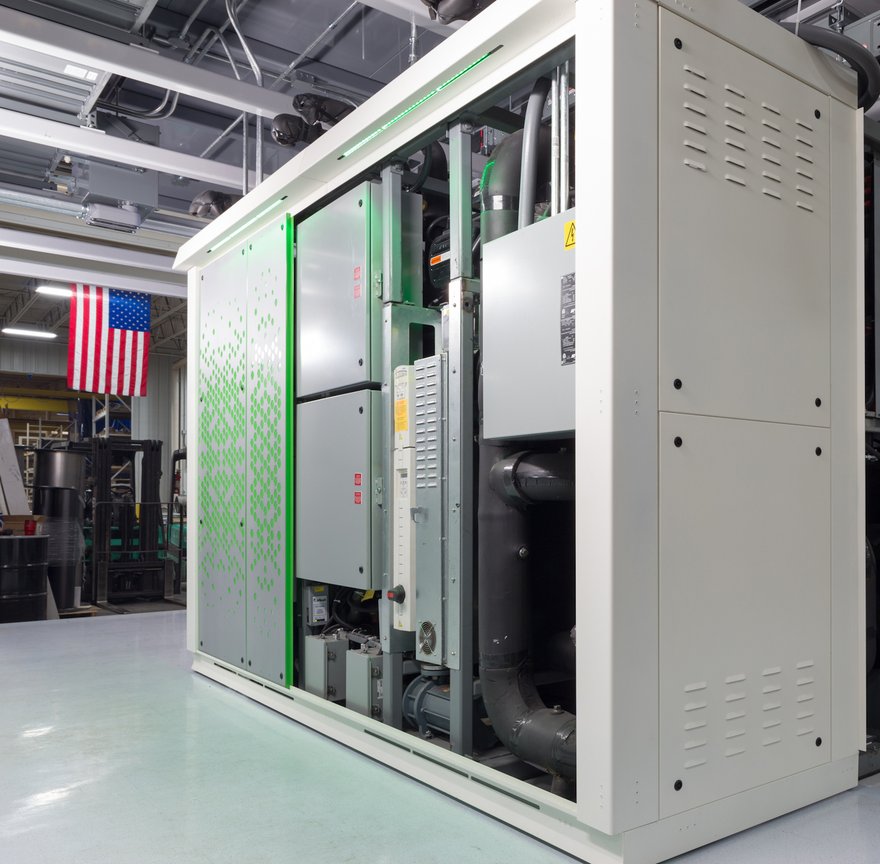
What Skanska and Inertech have developed is a modular water cooling system which can deliver efficient cooling at power loads whether they are running at 4-5kW per rack or 40-50kW per rack.
It is called eOPTI-TRAX - a patent-pending cooling approach Skansa says has achieved a record-setting 1.012 mechanical Power Utilization Effectiveness (PUE) reading in repeated testing.
The tests were conducted by a leading research team from the University of Maryland’s Department of Mechanical Engineering.
The industry is waiting to hear more. Included in the questions asked are: What exactly is mechanical PUE? (see below).
But before we get into the technology debate let’s look at what Skanska and Inertech claim their system can deliver.
“This test dramatically ends the air debate,” said Earl Keisling, CEO of Inertech. “The spread in efficiency multiplies significantly in warmer climates. Moreover, we can handle densities up to 50 kW per rack and also eliminate server fans, saving more than double the system’s energy use to achieve net-zero added energy.”
The company is only saying so much about exactly how the system works and has focused on the results it has delivered under test.
Third-party test results
“We test systems from manufacturers across the globe,” said Dr. Ming Zhang, a researcher from University of Maryland who led a team of third-party researchers in performing the tests. “The efficiency, robustness and automation of the eOPTI-TRAX system are truly unique. These PUE readings are at least four times more efficient than simply moving air under ideal conditions, and much more efficient than traditional systems designed to the same level of reliability.”
Additionally, test results reveal the energy efficiency was nearly the same from full capacity down to 30% load, solving a problem that has long plagued the data center industry: how to achieve a low PUE and maintain efficiency under lightly loaded IT conditions as well as extreme dense loads, a statement said.
The test aisle was configured with dynamic loads including ramping rack loads up to 32 kW per rack. The system was able to fully handle up to a 93F Delta T and maintain a controlled environment with a 77F aisle temperature while introducing no outside air. The PUE includes all loads to fully cool the system. The system was able to maintain less than two percent total mechanical overhead all the way down to 30% loading.
Backgound in Chillers
Keisling said: “My background is building chiller plants for high-rise buildings. But what I found on this journey is that there are far better ways to handle this [variable data center heat load] than with traditional chillers. We focused on how to transport as much heat as quickly as possible and how to design a system to go from very low density to high density without capital expansion. That meant doing it with cooling coils inside the rack level with a design that is inside the hot aisle.”
Thermodynamically air is not a good conductor of heat and we know that some of the internet companies that created big air-handled data centers are having humidity issues or big temperature swings, he says.
Carnemark says Skanska’s approach was to rethink each component in the data center in order to deliver infrastructure that was as elastic as the IT stack without introducing huge upfront capital cost. ‘We’re the cost barrier,” he says in reference to maintaining parity with the rapid IT developments which are straining the efficiency limits of cooling and power provision.
“I want to get to where we’re charging the client for the IT load and nothing else,” he says.
Join the Debate
Skanska’s claims have sparked some debate – see the reactions and add your comments at the DatacenterDynmanics Linkedin Group.