
Luxembourg’s satellite giant SES has announced tests on optical ground stations using technology from French start-up Cailabs to explore faster downstream throughput for satellites sending data down to Terra Firma.
Cailab’s Multi-Plane Light Conversion (MPLC) technology is intended to compensate for the usual barriers to this technology’s use, potentially granting an experimental disruptive advantage.
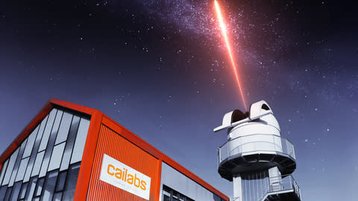
Last week, Cailabs announced it had raised €57 million ($67m) in additional capital to fuel the testing of its space-to-Earth optical technology, €37m ($43m) of which comes from the European Investment Bank (EIB). Others include the French Ministry of Armed Forces, Luxembourg’s NewSpace Capital fund, Crédit Agricole, and the European Council for Innovation (EIC). That investment is on top of €26m ($30m) raised in December 2022, and €8m ($9m) in October 2019, making for €91m ($106m) in total investment.
“Optical communication can provide much higher bandwidth, better data security, and less risk of spectrum congestion,” said Carmel Ortiz, SVP of MEO programs at SES, in a statement. “The Cailabs optical ground stations can play a central role in our global network of gateways with access to high-throughput infrastructure."
Optical connections are faster than those by radio waves, avoiding spectrum congestion, and cannot be conventionally intercepted by cyber threats, but are hampered by weather, with the laser beam requiring clear and calm weather to work optimally, with even high winds capable of affecting transmission.
The companies estimate optical technologies can transmit data up to 100 times faster than the speeds of home Internet, at 10 gigabits per second, and that the cyber-resilient nature of the transmission makes it uniquely suitable for government and military use.
Founded in 2013, Rennes-based Cailabs’ MPLC technology constantly adjusts the transmission of the beam to adjust for atmospheric conditions, adapting the beam to remain performing optimally, though the barrier of heavy cloud cover is likely to remain a challenge.
The new ground stations that will test the technology, called TILBA-OGS L10, will fine-tune the solution ahead of its commercial rollout. Cailabs expects to be deploying up to 50 optical ground stations a year by 2027.
“Our optical ground station technology, already field-proven with a variety of satellites and terminals, offers top performance in mitigating atmospheric turbulence and maintaining resilient communications, while delivering features that are essential for secure communications in today’s most demanding environments,” said Jean-François Morizur, CEO of Cailabs, in a statement.
Last month, Cailabs transferred its U.S. headquarters from Washington, D.C. to larger offices in Arlington, Virginia, an infamous hub for defense developers in the country.






Comments