
Sandia National Laboratories has launched the Spectra supercomputer, the second system released under its Vanguard program to test chip architectures for national security applications.
The supercomputer uses Maverick-2 accelerators from startup NextSilicon, which hopes to compete with Nvidia for high-precision workloads, while the GPU giant increasingly focuses on lucrative low-precision AI work.
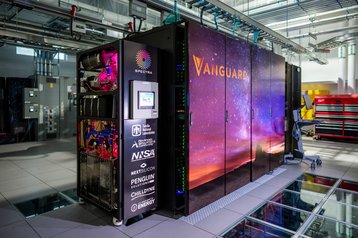
Sandia has been working with prototype NextSilicon hardware for the past three years, with Spectra co-developed by the lab and the chip company. Penguin Solutions integrated the thermal management and power distribution systems, which included a Chilldyne negative-pressure liquid cooling system.
The supercomputer features 128 of the Maverick-2 dual-die accelerators, which analyze code to prioritize tasks in real time. This, the company claims, lowers the power consumption of the system.
“We have deployed a first-of-its-kind computing capability,” said Sandia senior scientist and project lead James Laros.
“And it’s the result of this tremendous partnership between the national labs and industry.”
The supercomputer will be used by Sandia, Lawrence Livermore, and Los Alamos under the National Nuclear Security Administration’s Advanced Simulation and Computing program. The consortium will test Spectra on advanced fluid dynamics simulations, before being used for more advanced nuclear weapons research.
“By deploying prototype systems, we investigate whether new technologies can be integrated into our large production platforms in the coming years,” said Simon Hammond, director of the Office of Advanced Simulation and Computing and Institutional Research and Development Programs at the National Nuclear Security Administration.
Sandia launched the first Vanguard system, Astra, in 2018. That supercomputer was an early deployment of Arm chips, now commonplace in the data center.
“While it seems obvious today that Arm-based processors can handle demanding workloads, at the time of Astra’s deployment the software stacks, compilers and libraries were untested and lacked necessary optimizations for production environments,” Hammond said.




Comments