
Samsung Electronics has signed a Memorandum of Understanding (MoU) with AMD that will see the partners collaborate on AI memory technologies and foundry services.
The agreement will see Samsung supply AMD with its next-generation high-bandwidth memory (HBM4) for the company’s forthcoming Instinct MI455X GPUs, in addition to advanced DDR5 RAM solutions for its sixth-generation AMD Epyc CPUs, codenamed Venice.
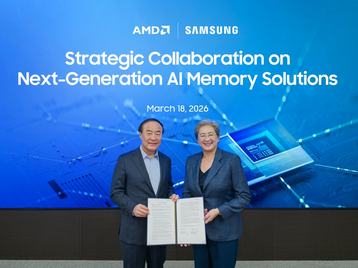
The two companies will also discuss opportunities for a foundry partnership, through which Samsung would provide foundry services for next-generation AMD products, they said in a statement.
Samsung is the world’s largest memory chipmaker and announced last month that it had become the first company to start mass producing its advanced sixth-generation high-bandwidth memory, known as HBM4. Built using its 10nm DRAM process, the chips offer processing speeds of up to 13Gbps and bandwidth with a maximum 3.3Tbps.
“Samsung and AMD share a commitment to advancing AI computing, and this agreement reflects the growing scope of our collaboration,” said Young Hyun Jun, vice chairman & CEO of Samsung Electronics. “From industry-leading HBM4 and next-generation memory architectures to cutting-edge foundry and advanced packaging, Samsung is uniquely positioned to deliver unrivaled turnkey capabilities that support AMD’s evolving AI roadmap.”
Dr. Lisa Su, CEO of AMD, added: “Powering the next generation of AI infrastructure requires deep collaboration across the industry. We are thrilled to expand our work with Samsung, bringing together their leadership in advanced memory with our Instinct GPUs, EPYC CPUs, and rack-scale platforms. Integration across the full computing stack, from silicon to system to rack, is essential to accelerating AI innovation that translates into real-world impact at scale.”
The announcement comes as the industry attempts to grapple with a shortage of storage and memory hardware, with the size and scale of many recent AI data center build-outs seemingly having caught the market off guard and resulting in a capacity crunch.
Memory chipmakers Samsung and SK Hynix have also both warned that the memory chip shortage is predicted to continue into 2027 and beyond, with consumer electronics likely to suffer the most in the face of ongoing shortages, as capacity will increasingly become allocated to AI infrastructure projects.
In January 2025, the Wall Street Journal reported that data from TrendForce shows that up to 70 percent of the memory produced worldwide in 2026 will be consumed by data centers.



Comments