
Rolls-Royce is set to more than double the production of its diesel backup generation units for the US data center market.
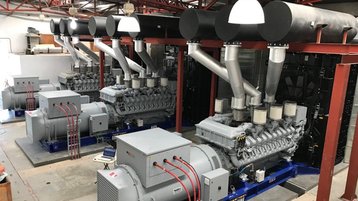
The company has earmarked $24 million to construct a new 250,000 sq ft Logistics Operations Center (LOC) located next door to its manufacturing facility in Mankato, Minnesota.
Rolls-Royce has said that it expects the investment to boost production levels at the Minnesota facility by more than 120 percent by 2026 compared with last year. The facility is slated for completion next spring.
The LOC will increase the company’s production capacity of its mtu Series 4000 generator sets, in an attempt to meet soaring demand across the country’s data center sector.
“The US market is very important to Rolls-Royce. We have a proud history in America, and we are committed to strengthening our presence to support further growth, bringing economic benefits and job opportunities,” said Tufan Erginbilgic, CEO of Rolls-Royce. “Today’s announcement is proof of the transformation of Rolls-Royce in action, enabling us to invest in areas of strategic focus, such as power generation.”
The investment is also expected to boost production capacity at Rolls-Royce’s Aiken, South Carolina facility, where the bulk of its mtu Series 4000 units are currently produced.
Joerg Stratmann, CEO of Power Systems, Rolls-Royce, said: “Our hyperscale data center customers have relied on our solutions and partnership for mission-critical power for over 15 years – a result of our strategic focus and continuous investment in this sector. This deliberate market positioning has enabled us to effectively address the exponential rise in demand from the data center industry, particularly in the US, where this critical new infrastructure will be built.”
The mtu Series 4000 generator set has become a mainstay in data center operations. According to the company, the majority of its Series 4000 engines can operate on synthetic paraffinic diesel fuels, including the biofuel hydrotreated vegetable oil. In addition, they can also be fueled with a 10 percent hydrogen blend.
While diesel backup units remain the primary option for data centers, companies are beginning to explore other low-carbon alternatives.
Last year, Microsoft and Caterpillar undertook a pilot project testing the viability of hydrogen as a backup solution for data centers at a Microsoft data center in Wyoming. According to the partners, they were able to demonstrate the viability of using hydrogen fuel cells to supply reliable and sustainable backup power to a data center for 48 hours.
Microsoft has also tested the viability of Battery Energy Storage as an alternative to diesel backup systems. In October 2023, alongside BESS developer Saft, Microsoft deployed 16MWh of battery storage at its Stackbo data center in Sweden to replace its diesel backup system.







Comments