
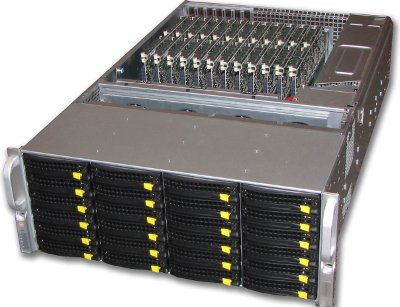

Penguin Computing launched an ARM-based server for scale-out architectures, using Calxeda’s System-on-Chip (SoC) server nodes.
Pitching it as a low-power, high-density solution, Fremont, California-based Penguin said its Ultimate Data X1 (UDX1) system was ideal for I/O bound workloads, such as analytics and cloud storage. Built on Calxeda’s ARM-based EnergyCore SoCs, UDX1 offers a power envelope of five watts per four-core node.
Penguin CEO Charles Wuischpard said typical cloud-computing, Web 2.0 and Big Data applications were based on scale-out architectures and needed new generation high-density energy-efficient servers to ensure the data centers that house them can handle the power and cooling load.
“With the incredibly low power envelope and the extremely high density Calxeda’s EnergyCore SoCs offer, the UDX1 is the ideal platform for running these types of workloads,” he said.
One physical UDX1 unit (a 2U form factor) can have as much as 48 server nodes, interconnected via an internal 10GbE switch. The system can provide up to 144TB of hard-drive capacity.
Penguin specializes in enterprise servers optimized for Linux. It offers both custom and off-the-shelf solutions built on Intel’s and AMD’s chips in addition to Calxeda’s.
ARM is a UK company that licenses its low-power processor design to chipmakers. It currently dominates the mobile-device market, but companies like Austin, Texas-based Calxeda have been pushing ARM processors into the server market, seeking to capitalize on data center power and cooling issues and the need for scale-out architectures.
EnergyCore SoCs are Calxeda’s first-generation ARM server nodes. Earlier this week, the company announced its product roadmap for the next two years, shedding light on what its second- and third-generation SoCs are going to look like.
The second-generation product, codenamed “Midway”, will be a 32-bit platform optimized to enable hardware vendors to build “cloud appliances”. Following Midway, Calxeda plans to release Lago, the third-generation 64-bit SoC designed to enable massive scale-out infrastructures.