

Two of the world’s largest stock exchanges reported soft financial results this week as both Nasdaq and Deutsche Borse missed analyst revenue estimates.
A third, NYSE Euronext, reports its results on Monday.
The company’s data center strategy has been placed at the heart of its business as the company builds out a network of liquidity centers across the globe.
When it opened in 2010 NYSE Euronext’s Basildon data center represented a huge strategy play for the stock exchange operator. Unlike Nasdaq it decided to not to rely solely on third party data centers from which to host its exchanges.
Instead it built two huge facilities, one on either side of the Atlantic, in Mahwah, New Jersey 30 miles from Wall Street and one in Basildon, Essex around the same distance from the City of London which acts as the hub for its European financial markets.
At the facility the physical infrastructure hasn’t changed much. It has still got seven halls, three of which are occupied and capable of running loads of up to 3MW per hall with all the redundancy and resiliency that was designed in. The company says the 20% of the facility will be used for its own activities and 80% available for colocation.
Basildon’s 100,000 sq ft of space mean realising a return on that asset requires a long term plan to maximise the utilisation of all of that power and space – NYSE quotes the investment in Basildon, named its European Liquidity Centre and its sister Liquidity Center in Mahwah, at $500m.
The European Liquidity Centre hosts its Paris, Amsterdam and Lisbon exchanges.
The exchange operator is now building out a network of points of presence across the world using its own and third party data centers. This is its Global Liquidity Center strategy. It lists these as Basildon, Chicago, Frankfurt, Hong Kong, Mahwah, Tokyo and Weehawken.
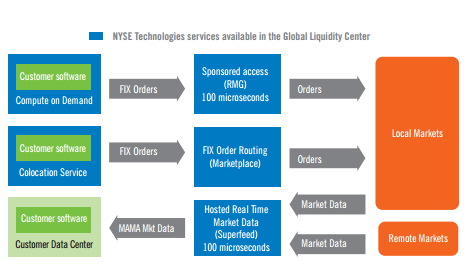
The firm will sell a combination of colocation and market proximity services based on its order routing, market data and Superfeed solutions.
Community building
Stanley Young, CEO of NYSE Technologies said in a video posting: “NYSE is building a global capital markets community in a virtual world. Connectivity is provided by networks. We can get you to your execution venue of choice, wherever it is in the world by applying our technology, gateways and market data infrastructure to enable trading. This is a move from running markets to running market infrastructure in the virtual world. Commission pools are getting smaller. Infrastructure is becoming more complex in terms of the technology footprint that you have to put out there to connect to all these markets globally. We offer access to global markets, market data and risk filters, working with traditional market participants to enable real time low latency trading.”
“The components of the offering are Secure Financial Transaction Infrastructure (SFTI), a secure reliable multi service network for buy side and sell participants to connect to markets of choice which provides the ability to get a trade from a buy side client to the sell side to the market. Marketplace service is through NYSE’s Risk Management Gateway (RMG). And Superfeed, a data aggregator which is NYSE’s ultra low latency feed handler, to acquire data from execution venues. We aggregate it in Superfeed and feed it back to the sell side or their algos, which informs and triggers the next trading decision.”
[This week saw NYSE Technologies move further into the Asian market by connecting its (SFTI) network to a data center in Singapore operated by the data center services provider SGX Transaction]
“Basildon and Mahwah house our own markets – we are evolving a strategy which will put data centers in major cities around the world – and each will have unique services but built around RMG, SFTI, and Superfeed. The data center strategy is essentially our community – linking participants to whichever market they wish to operate in. This redefines what it is to be an exchange operator.”
Products and Markets
For example, from Basildon for order routing and market data NYSE lists Colocated markets as: Goldman Sachs Sigma X; Luxemburg, NYSE Alternext, NYSE Arca Europe, NYSE Euronext, NYSE Liffe, Smartpool, SocGen Alpha Y.
And for order routing and market data Proximity services as: BATS Europe, Chi-X Europe, Equiduct, London Metals Exchange, London Stock Exchange, Markit BOAT, Plus Markets, Quote MTF, Turquoise.
For its Superfeed product its lists Colocated markets as: Goldman Sachs Sigma X, Luxemburg, NYSE Acra Europe, NYSE Euronext, NYSE Liffe, Smartpool.
And for Superfeed markets in Proximity: BATS, Chi-X, London Stock Exchange, Markit BOAT and Turquoise.
Policy Change
Tariq Rashid, is the European managing director for colocation services at NYSE Euronext.
He says over the last two years the company has changed policies to be more and more accessible both to its exchange member firms and to the broader market.
For NYSE’s 1300 buy and sell side customers the facility has always been open, now for service providers there is a broadening of the access options which extends participation to include non-NYSE market members while extending the services offered to its traditional customers.
“When we opened the facility we were offering rack space, so they (market members) took a cage or a rack – they supplied their equipment and we connected it. Now we will also offer compute on demand which is a secure cloud based service – currently in Mahwah in NJ – soon to be available in Europe,” says Rashid.
This is NYSE’s Capital Markets Community Platform which is available in the US and which will be launched in Europe later this year.
This is an infrastructure as a service offering which will see NYSE supplying the IT – EMC and Vmware are named suppliers – and is pitched as a cloud offering to allow rapid deployment and access to NYSE services. In addition this opening up access into Basildon means offering standard colocation in various rack sizes and private cages and NYSE will provide plug and play fully managed, compute on demand services.
“We have a range of participants who want to get close to our markets – all capital market participants want to get as close as possible to the matching engines. A very small player might want to take one or two blades – others might want to take a more significant footprint,” says Rashid.
Physical Changes
There are a number technology developments at the site including the option for liquid immersion cooling for companies wishing to run ultra high clock speeds on multi-core servers.
On the connectivity side NYSE Euronext has a proprietary network but has now allowed firms to deploy their own fiber in the data center. One of the first movers was Colt which said it can offer low latency to the Frankfurt exchange from Basildon.
Another development was allowing member firms to install microwave networks in the facility.
The selling point for NYSE is that clients can deploy in its liquidity centers within one month of signing an contract including installation, testing and pilot. It offers full resiliency, 10GB Ethernet and multi core servers backed by monitoring problem resolution and capacity planning.
The site also has 2,200 photovoltaic panels on the roof – one of Europe’s largest solar panel deployments - which at peak output will generate 600kW of power.
NYSE has no shortage or power or space at its liquidity centers in the Mahwah and Basildon and it is building out its services portfolio and market reach through its global liquidity center strategy.
Rashid says there is a 20 year plan in place. This is anchored around the enormous infrastructure investment.
Financial Results
The background to a lot of this is the failure of the planned super merger. In February this year the European Commission blocked the $9bn merger of NYSE Euronext and Deutsche Borse saying it would stifle competition.
This week Deutsche Borse reported its financial results. The company reported profits down 31%. Net income slipped to 146.2 million euro ($193 million) from 214.1 million euros in the first quarter of 2011.
Nasdaq reported flat Q1 revenue of $411 million from $413 million. Income was $85m down from $104m for last year’s Q1.
Both exchanges cited lower trading volumes.
NYSE Euronext reports its financials on Monday 30th April.