
Nvidia has launched the Vera Rubin DSX AI Factory reference design, a guide to building data centers that support its latest CPU-GPU racks and Spectrum-X Ethernet networking and storage.
The Nvidia Omniverse DSX Blueprint, which is a digital twin for large-scale design, buildout, and operations, is also generally available today and supports the new reference design.
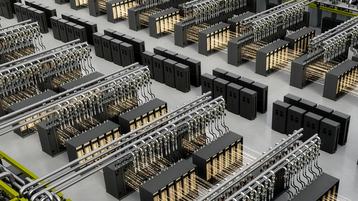
The Vera Rubin DSX design was developed in partnership with Cadence, Dassault Systèmes, Eaton, Jacobs, Nscale, Phaidra, Procore, PTC, Schneider Electric, Siemens, Switch, Trane Technologies, and Vertiv.
“In the age of AI, intelligence tokens are the new currency, and AI factories are the infrastructure that generates them,” said Jensen Huang, founder and CEO of Nvidia.
“With the Nvidia Vera Rubin DSX AI Factory reference design and Omniverse DSX Blueprint, we are providing the foundation to build the world’s most productive AI factories, accelerating time to first revenue and maximizing scale and energy efficiency.”
Rubin DSX includes a number of software libraries. DSX Max-Q is focused on maximizing computing output and token performance per watt on Nvidia systems within a fixed power budget. DSX Flex connects AI factories to power-grid services, enabling them to dynamically adjust power use and orchestrate demand with hybrid onsite generation to save energy and maintain grid stability.
DSX Exchange enables scalable and secure integration of compute, network, energy, power, and cooling plant signals between IT, operational technology, and operations agents.
DSX Sim models validate AI factories as high-fidelity digital twins, using the DSX Air platform to model GPUs, networking, and partner infrastructure, and DSX SimReady connects detailed 3D geometry, logistics, and system behavior.
CoreWeave said that it is using DSX Air to build and test digital twins of AI factories in the cloud. Phaidra said that it has integrated DSX Max-Q into its new self-learning AI agent to deliver about 10 percent more compute by reducing cooling spikes.



Comments