
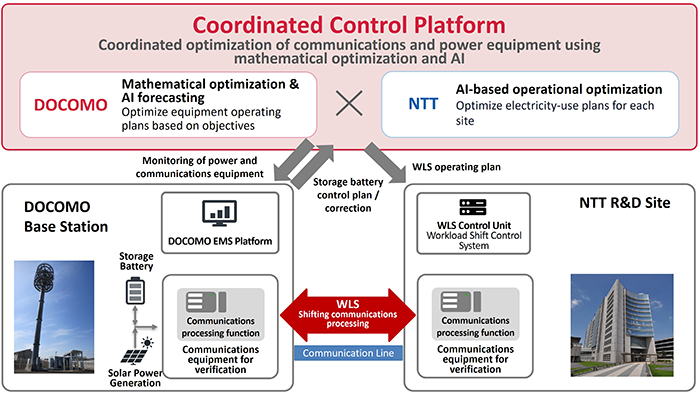
Japanese telecom firm NTT Docomo and its parent company NTT have announced a solution that uses AI to coordinate and control radio base station communications-processing workloads and the operation of distributed energy resources (DER), including solar and battery storage.
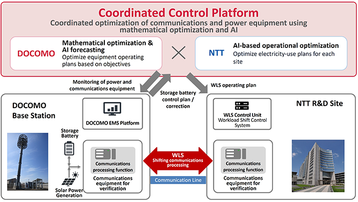
The companies have launched a joint demonstration to verify the new technology’s effectiveness in increasing renewable energy use and supporting demand response during peak demand periods. In addition, the project will seek to improve the continuity of communications services during disasters. The demonstration will be the first time the technology has been deployed at a base station.
According to the companies, conventional base stations have generally used independently controlled communications and power equipment, making it difficult to operate communications equipment in response to renewable energy generation under normal conditions or to coordinate during outages.
The project will use workload shifting (WLS) technology to move communications-processing workloads between base stations, along with Docomo's energy management system, which can manage DERs. Under current plans, which the companies calculated using AI, NTT will control the communications load at each station, while Docomo will control the storage batteries.
NTT will build a verification environment using open-source software to simulate the communications processing performed by a virtualized radio access network. The environment will then connect to Docomo’s base stations, allowing the companies to test the technology's effectiveness.
The companies intend to demonstrate the system's ability to increase renewable energy use and help stabilize the power grid through DR when electricity supply and demand are tight. The companies said this will enable the base stations that handle communications processing to switch flexibly in response to renewable energy generation, using previously underutilized renewable energy.
Docomo and NTT plan to complete the demonstration by the end of December 2026 and evaluate this new technology's effectiveness. The companies have floated the possibility of linking the technology to data centers and, in the future, extending it to a wider range of energy sources.
NTT has a significant data center portfolio, with much of it based in the APAC region. Earlier this month, it was reported that the company was finalizing an agreement with Anthropic for the development of a $6.3 billion data center in Western Japan.
NTT Docomo is a subsidiary of the NTT Group and Japan’s largest mobile phone and wireless carrier. It serves more than 73 million customers in Japan across its mobile, 5G, and expanded digital services network.

Comments