
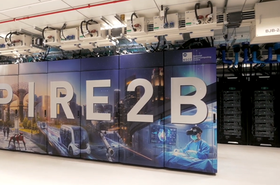
Nokia has partnered with server IT equipment manufacturer Hypertec for the deployment of the Nibi supercomputing cluster at the University of Waterloo in Ottawa, Canada.
The cluster will be integrated into the SHARCNET (Shared Hierarchical Academic Research Network) supercomputer, designed to support health, climate science, engineering, and AI research projects.

Comprising 134,000 Intel Xeon 6 (Granite Rapids) cores, 288 Nvidia H100 GPUs, and more than 25 petabytes of storage, the Hypertec-designed system is interconnected by Nokia 400G Ethernet. Nibi also features nine single-phase immersion cooling tanks and uses direct-to-chip liquid cooling for its GPU subsystems.
The use of immersion cooling has resulted in a reduction in up to 50 percent in cooling energy, when compared to air cooling, with the system offering 100 percent heat reuse, with the waste heat used to warm the Mike and Ophelia Lazaridis Quantum-Nano Centre, the university’s quantum R&D laboratory.
Nibi is Canada’s first large-scale immersion-cooled supercomputer and the first HPC cluster based on Intel Xeon 6 processors to be deployed using immersion cooling. It was built to replace the university’s previous flagship supercomputer, Graham, which was retired in late 2025.
The system, which ranked 186 on the most recent edition of the Top500 list, is available to staff, students, and research fellows at Canadian academic institutions. Nibi is supported by 19 academic partner institutions, making it the largest HPC consortium in Canada.
“The Nibi supercomputer significantly expands Waterloo’s capacity to support advanced computational research,” said Charmaine Dean, VP, research and statistics, and actuarial science professor at the University of Waterloo. “By working with Nokia and Hypertec, we gain access to world-class AI and high-performance computing infrastructure that combines scalable system design with high-performance Ethernet networking, advancing the next generation of Canadian research and reinforcing Waterloo’s long-standing leadership in computation."




Comments