
Chip startup NextSilicon has disclosed architecture and performance details for its Maverick-2 accelerator, and claims it can outperform GPUs from Nvidia and CPUs from Intel.
The company has also announced the development of a new RISC-V test chip, dubbed Arbel.
Built to target high-performance computing artificial intelligence (HPC-AI) applications, when announced in October 2024, the Israeli firm claimed the Maverick-2 was the world’s first Intelligent Compute Accelerator (ICA) – a “novel and original computing architecture” that achieves increased performance whilst cutting power consumption and costs.
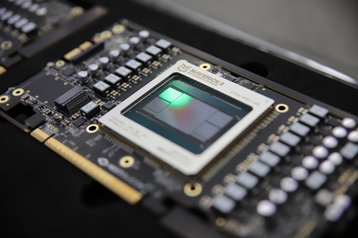
NextSilicon has published benchmarks showing that, based on internal testing and publicly available power and performance information, the Maverick-2 delivers 4x the performance-per-watt compared to the Nvidia HGX B200 GPU for FP64, and more than 20x performance-per-watt than the Intel Xeon Sapphire Rapids CPU for FP64.
The company also claims that the total energy costs for Maverick-2, compared to Nvidia HGX B200, are less than half.
In GUPS (Giga-Updates Per Second) testing benchmarks, NextSilicon’s ICA achieved 32.6 GUPS at 460 watts in AI inferencing scenarios, 22x faster than CPUs and almost 6x faster than GPUs; and was comparable to leading GPUs in HPCG (High-Performance Conjugate Gradients), achieving 600 gigaflops at 750 watts, while consuming half the power.
"For eight decades, rigid hardware designs have forced software to adapt, with modern CPUs dedicating roughly 98 percent of silicon to overhead and just two percent to actual computation,” said Elad Raz, founder and CEO of NextSilicon. “Maverick-2 flips this paradigm on its head by devoting the majority of hardware real estate to compute, moving runtime overhead management to intelligent algorithms and software in real-time through our dataflow architecture.”
Built on TSMC’s 5nm process technology, the Maverick-2 ICA is available in a single-die PCIe format with 96GB of HBM3e memory and a maximum power consumption of 300W, while its dual-die Open Accelerator Module (OAM) offering contains 192GB of HBM3e and has a maximum power consumption of 600W.
Similarly, NextSilicon’s newly announced RISC-V Arbel chip will also be built on TSMC's 5nm process, with the startup already claiming that the chip “surpasses current RISC-V competition, as well as Intel LionCove and AMD Zen 5.”
In comments published alongside the announcement, NextSilicon said that choosing RISC-V over Arm architecture was a “strategic decision that goes beyond simple architectural preference,” and instead represents “a fundamental shift toward an open and adaptable future” that will allow the startup to develop its own patented IP from the ground up.
“As AI and HPC workloads evolve, Maverick-2’s intelligent, adaptive design ensures our customers' investments remain future-proof while delivering unparalleled performance today. With its pioneering dataflow architecture already transforming computing, and Arbel showcasing our ability to engineer world-class, general-purpose silicon, we’re setting a bold new standard for what’s possible,“ Raz said.
No release date for Arbel has been disclosed, and NextSilicon said additional details on Arbel benchmarks will be released as progress is made beyond the test-chip phase.
Founded in 2018, NextSilicon has raised more than $303 million across four funding rounds. Investors include Third Point Ventures, Playground Global, Aleph, Playground Global, and Amiti Ventures.





Comments