
Cisco came out swinging in the EMEA leg of its continental Live tour, unveiling a slew of hardware and software updates it claims will help AI network operators boost performance and reliability.
Here’s everything you need to know from the ground:

G300: Next-gen silicon to power distributed clusters
Front and center of Cisco’s EMEA showcase was the Silicon One G300, a custom solution set to power its latest servers.
Described by Cisco president and chief product officer Jeetu Patel as a “massive differentiator,” the network application-specific integrated circuit (ASIC) and latest in its Silicon One line can support switching speeds of up to 102.4Tbps.
The hardware offers what Cisco describes as “intelligent collective networking,” in which a shared packet buffer, path-based load balancing, and proactive network telemetry are combined to push performance for data center deployments. The vendor claims the underlying software routing component provides 33 percent increased network utilization and a 28 percent reduction in job completion time versus simulated non-optimized path selection.
It’s also designed to be highly programmable, with Cisco wanting its Silicon One-based products to be able to be upgraded for new network functionality even after initial deployment.
The G300 was the flagship announcement of a Cisco event where scale out (server-to-server) and scale across (distributed data centers powering workloads in tandem) were the stars of the show amid the vendor’s growing push into the data center space.
Patel, during the event’s keynote, said he expects scale-across networking to be at “continental scale” in the future, and that the company was building high-performance solutions like the G300 that can “satiate the needs of these AI data centers at scale.”
“[The G300] is a massive differentiator. We make our own silicon, and this becomes one of the biggest differentiators of why you should partner with Cisco,” Patel said, claiming it was “the most programmable silicon chip that you will see in network cases.”
Server updates: New lines & expansion times
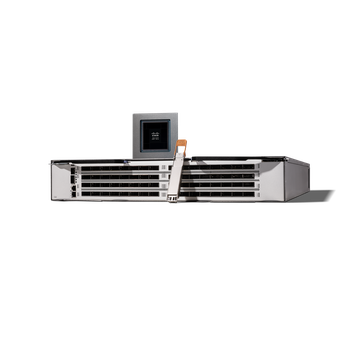
Product lines featuring the G300 will start to ship later this year. Among those are the new Cisco N9000 and 8000 fixed and modular Ethernet systems.
Coming in liquid-cooled and air-cooled designs, Cisco claims its latest server line offers “significantly higher bandwidth density,” culminating in a nearly 70 percent energy efficiency improvement.
The networking giant, in an even bolder claim, asserts that its new N9000 and 8000 systems achieve the same bandwidth in a single unit that six of its previous-generation systems would have required.
The Amsterdam event also saw Cisco confirm more of its servers would feature its previously announced P200, including the aforementioned N9000.
Unveiled last October, the P200 network ASIC supports 51.2Tbps and first featured in the 8223 series chassis, which were aimed at hyperscale deployments.
The addition of P200-powered N9000 systems sees Cisco extend its capabilities to customers, including neoclouds, enterprises, and service providers.
1.6T and 800G pluggable optics
Joining the switches and servers was a new line of 1.6 Tbps (1.6T) pluggable optics designed to support scale out in AI data centers.
The coherent transceivers aim to provide ultra-high bandwidth connectivity for switch-to-network interface card (NIC) or switch-to-server links.
For operators not at the performance level requiring 1.6T optics, Cisco also showcased a line of 800 Gbps (800G) units for scale-out networks. The vendor claims it can reduce optical module power consumption by 50 percent compared to retimed optical modules.
Martin Lund, EVP of Cisco’s Common Hardware Group, commented: “As AI training and inference continues to scale, data movement is the key to efficient AI compute; the network becomes part of the compute itself. It’s not just about faster GPUs – the network must deliver scalable bandwidth and reliable, congestion-free data movement.
“Cisco Silicon One G300, powering our new Cisco N9000 and Cisco 8000 systems, delivers high-performance, programmable, and deterministic networking – enabling every customer to fully utilize their compute and scale AI securely and reliably in production.”
Nexus One & Unified Fabrics
Away from hardware, Cisco’s EMEA event saw the unveiling of Nexus One, a management platform that acts as a unified fabric, enabling customers to rapidly deploy and manage their networks in line with changes in workload demands.
The Unified Fabric component brings together silicon, systems, optics, and software into a single control plane that provides operators with deeper insights and visibility across network telemetry, all the way to the GPU.
From March, Nexus One will also be able to analyze network telemetry directly where its data resides, thanks to an integration with the Splunk platform. That eliminates the need for users to move telemetry data to external platforms – an addition the vendor touts as an “essential capability” for sovereign cloud deployments.
AIOps? No. AgenticOps
Cisco recently went all in on agentic AI for its XDR platform. But the agentic hits kept on coming with news from the Amsterdam show floor that its AgenticOps offering would be added to more of its product lines.
Introduced last June, AgenticOps is essentially a framework for employing AI-infused tools capable of augmenting network operations without the need for human intervention.
Already featured in offerings like AI Canvas, Cisco is now bringing its framework to areas like campus and industrial deployments, freeing up engineers by performing end-to-end troubleshooting investigations.
It’s also being positioned for the data center space, with operators able to obtain insights from across both traditional and AI workloads. While in the service provider realm, Cisco claims AgenticOps can help identify, diagnose, and resolve complex, multivendor issues in its networks.
“By delivering agentic capabilities aligned to critical IT operations priorities, we’re combining Cisco’s unique cross‑domain visibility, purpose-built models, and governance together to supercharge teams,” Patel added.
AI Defense expansion and AI-aware SASE
Cisco's Amsterdam event also saw major security announcements aimed squarely at the emerging risks of autonomous AI agents.
The company's AI Defense platform received its biggest update since its launch in January 2025, adding AI bill-of-materials (BOM) capabilities for supply chain visibility, an MCP Catalog for discovering and managing tool servers, and real-time guardrails that continuously monitor agent interactions to detect manipulation attempts or poisoned tools.
On the secure access service edge (SASE) networking side, Cisco SASE is getting AI-aware with capabilities like intent-based inspection that evaluates the purpose behind agentic messages, MCP visibility, policy controls, and traffic optimization techniques designed to keep AI workflows running reliably during load surges.
The updates also extend to Cisco's routing and switching portfolio, with IOS XE 26 delivering what the vendor claims are industry-first full-stack post-quantum cryptography (PQC) protections across its 8000 Series Secure Routers and C9000 Series Smart Switches.
“As agents take on critical enterprise roles, we're developing protections that work both ways: preventing agents from being compromised and controlling what they can access and do on our behalf,” Patel said.


Comments