
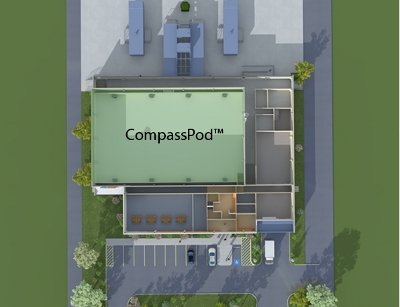

The year drawing to a close saw a couple of new data center providers offering modular solutions enter the market, and an existing modular data center company grow. The two new companies are NextFort and Compass Datacenters, and the existing one is IO.
The three firms’ models differ from one another, except for one key aspect: modularity. Modular approach to capacity build-out works especially well for companies that provide data center space commercially, since it reduces upfront costs.
IO and Compass’ models have another common aspect: they both offer to deploy data center capacity anywhere a client wants, instead of being tied to a larger campus (although IO does also offer modular space inside large buildings it owns).
Compass, created by one of Digital Realty Trust’s founders Chris Crosby and a partner, announced itself to the world in April. By the end of the year, the company had raised US$45m in debt and signed contracts with a customer to build two 1.2MW data centers.
Here are the things Crosby thinks will be important for the data center industry in 2013:
- The term Big Data will become as ubiquitous as the Cloud and still nobody will know exactly what they mean.
- DX with airside economization will begin to replace water based systems as the cooling methodology of choice due to 1) continued pressure to reduce energy costs, and 2) scarcity and increased cost of water.
- Federal regulation of coal fired power plant construction will increase costs for data center providers and their customers.
- Integrated BMS/DCiM solutions will become a standard part of data center offerings.
- The trend toward "outsourcing" the data center (vs. DIY) will accelerate among all three segments of the market: small companies (cloud), medium sized companies (colocation), and large companies (wholesale).
IO also raised some capital this year – $90m to be exact – and expanded its operations into Europe, while securing a multitude of new customers. IO execs, on their part, have chosen to focus their predictions on the trends in adoption of modular data centers in the industry:
Data Center 2.0: Traditional, facility-based data centers (Data Center 1.0) are too costly and slow-moving for today’s IT and business challenges. In 2013, we will see an accelerated move to a Data Center 2.0 model where data center infrastructure is completely separated from physical real estate. With this model, data centers are now an IT product; comprised of modular data center hardware and data center operating system software. With this move, organizations can reduce capital investments and only purchase what they require – while retaining the ability to quickly add new capacity as needed.
The race for sustainability: Data centers are increasingly being called out as big polluters that require crippling energy costs. The lifetime energy costs of a data center typically run 150% of the initial capital costs. This will drive modular design adoption in 2013 that significantly cuts floor space requirements, which translates into lower cooling and air-handling requirements, and lower power consumption.
The cost of free: Every time users add something to the Internet, they are actually adding it to a data center somewhere. Free services like Facebook, email, personal cloud-based storage and much more all have costs – and these expenses are absorbed at the data center. In 2013, companies will more closely examine “the cost of free” and how to make data centers more efficient to reduce costs.
Software-defined data center infrastructure: Data centers have been traditionally separate from the rest of the IT stack, missing out on the benefits software automation and optimization can bring. Data center infrastructure management (DCIM) software adoption will accelerate in 2013 as companies look to gain a single view of all their data center assets to maximize availability and efficiency.