

Calxeda, Austin, Texas-based maker of ARM processors for servers, is in the advanced stages of developing its second-generation product, a System on Chip (SoC) architecture tailored to enable hardware makers to build rack-size appliances optimized for public and private clouds.
The second-generation SoC is codenamed “Midway”, a 32-bit platform that uses standard CortexA15 ARM cores but delivers better performance, more memory and support for hardware virtualization, Calxeda said Wednesday.
The company’s founder and CEO Barry Evans said Midway and its third-generation platform called “Lago” (also announced Wednesday) were logical steps toward large-scale computing infrastructures.
“Now we are taking it two steps further to reinvent the server, first into a rack-based cloud appliance, and then extending into an integrated fleet of computing resources, spanning many thousands of efficient servers,” Evans said.
Lago will be built on the 64-bit ARM V8 architecture and feature Calxeda’s scaling features called Fleet Services, designed to automate and optimize common operations at scale. This capability is also often referred to as “fabric”.
Its fabric, Calxeda said, will connect hundreds of thousands of nodes and will be able to allocate and control those computing resources. “Lago will be in the first wave of 64-bit complete systems and application stacks on ARM in 2014, and we are collaborating with key partners to ensure that customers can ramp quickly with production-quality software and OS support for both Midway and Lago,” Evans said.
Calxeda plans to ship Midway systems in volume in 2013, while Lago is expected to hit the streets in 2014, as Evans mentioned.
The company licenses the technology behind its processors from ARM. The British firm’s low-power processor technology is currently dominating the mobile-device market, but there is increasing interest in using these “wimpy-core” processors in data centers as a way to reduce their energy consumption.
Earlier this month, Calxeda closed its third financing round, raising US$55m from new and existing investors. The company has raised $100m to date.
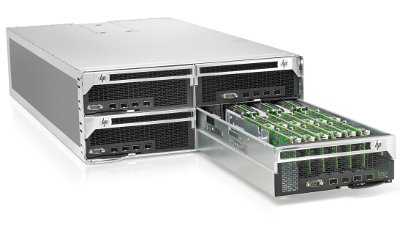
Hardware vendors that have built server systems around Calxeda’s SoCs include HP, Boston Limited and Penguin Computing. Penguin announced the availability of its Calxeda-based system, called Ultimate Data X1, today.