
Microsoft has unveiled Majorana 2, its latest topological quantum chip.
The company said the chip, which features a “next-generation materials stack,” will help it achieve a scalable quantum computer by 2029, cutting the original timeline Microsoft had been targeting in half.
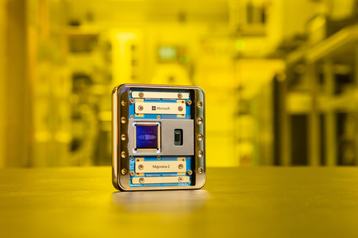
Microsoft further claimed that Majorana 2 is 1,000 times more reliable than its predecessor, Majorana 1, as its qubits can survive for an average of 20 seconds, rather than milliseconds, with some instances lasting as long as one minute.
Following the February 2025 launch of Majorana 1, Microsoft CEO Satya Nadella said the company had “a clear path to a million-qubit processor." However, where the first iteration of the Majorana chip only scaled to eight qubits, the BBC reported that the Majorana 2 chip has scaled to 12 qubits.
Microsoft’s Majorana chips are named after the previously hypothesized Majorana particle, which Microsoft now believes it has proved. The new class of materials, known as topoconductors, allows the system to create topological superconductivity.
Topoconductors are an entirely new state of matter, Microsoft claims - not a solid, liquid, or gas but a topological state.
In a blog post detailing Majorana 2, Chetan Nayak, Microsoft technical fellow, said that, unlike the original Majorana superconductor, which used aluminum, the new chip has a lead superconductor, helping to “shield fragile qubits from cosmic disturbances that can make them unstable.” Nayak said this “fairly large change” led to “big improvements in device quality.”
Nayak added: “We need to make improvements each year that will get us closer to delivering a computer that we believe will have massive commercial and societal value. We’ve got to keep marching to that roadmap to accomplish that, but where are we relative to last year? We’re 1,000 times better.”





Comments