

Microsoft is in talks with a number of municipalities to find an appropriate public-private partnership to test a prototype of a Data Plant – a data center that generates its own power and can function completely independently of the electrical grid.
What the company’s Global Foundation Services team hopes will make this possible is the fuel-cell technology it is researching, Christian Belady, general manager of data center services at Microsoft, wrote in a blog post Wednesday.
The fuel cell will be powered by biogas. By building a data center with such a fuel cell directly on a water-treatment plant or a landfill site (both significant sources of methane), an operator can eliminate the need to transmit biogas or electricity to long distances with all the resulting energy losses.
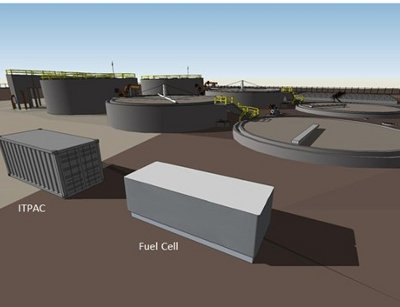
Rendering on the top-right shows a Microsoft ITPAC data center module and a fuel cell on site of a water treatment plant
The only thing a Data Plant will transmit is data, which will then be treated as another form of energy.
“Our team has been focusing on this since last year,” Belady wrote, “and right now it's really about how do we integrate even beyond what we've done already? How do we integrate from the chip all the way out to the utility, but not only from a hardware perspective? How do we integrate across that whole stack and make the right tradeoffs to drive the most sustainable, affordable solution?”
Belady has been talking about this idea publicly since 2010, and his team has made substantial progress to date. The company has filed papers to patent the Data Plant, Belady and one of its colleagues Vijay Gill wrote in a blog post earlier this week.
A 200kW prototype data plant can offset more than 2m pounds of CO2 emissions per year, Belady wrote. Since it will consume methane directly from the source, not only will it not need coal or nuclear energy, it will prevent tons of methane from being flared and converted to C02.
A data plant can still be connected to an electrical grid either for back-up or to feed excess energy it generates into the grid.