
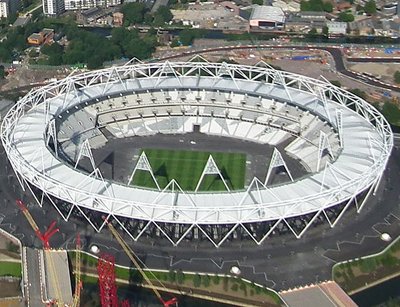

After the success of the London 2012 Olympics, this is an opportune time to consider the prospects for the London data center market.
CBRE has been tracking carrier-neutral colocation take up and supply across Europe for more than 12 years and while London continues to be the largest European hub – commanding 48% market share – the graph below shows the decline in the rate of data center take up from the peak year of 2007. On initial examination this is concerning, but what can also be seen is that take up of space is still positive with 19,090 sq m being taken by end users in 2011 alone.

This decline is closely linked to the wider performance of the European economy, which continues to dictate the level of new IT spend. The news for the colocation market is positive, however. This proves that corporates are now procuring data center space differently. The main trend since 2008 has been the reduction in corporate self-build data centers as companies switch from CAPEX to more flexible OPEX models. Companies with cash reserves have sought to use these to fund business growth while limiting spend on new infrastructure. This has resulted in the growth of colocation.

Due to budgetary constraints corporates are taking smaller, incremental amounts of space with a preference for shorter, more flexible terms. The graph to the right shows the average IT power load transaction size in the wholesale data center market since 2007.
What can be seen is the shrinking size of wholesale requirements in the sector from a 2007 average of just over 2MW of IT load to a 2012 (to date) average of 855kW. This trend has resulted in the growth of the ‘midi market’ characterized by IT power loads of between 200-750kw sitting between smaller ‘retail’ demand (traditionally below 200 kW) and larger ‘wholesale’ demand (above 750 kW). This is a trend we predict will continue for the next two years.
The charts highlight what we have seen happening in the industry in the past few years, namely the pre-2008 sentiment to take larger tranches of space to satisfy the exponential corporate demand expected at the time. Post 2008, it is evident that given the change in the global economy, demand growth has slowed. Companies now prefer smaller, more flexible, consumption models resulting in the average size of deals in terms of IT load falling.
Supply – exploding the myth
London continues to be a primary destination for multinational companies. Contrary to recent market reports, we believe the data center market is not in short supply but rather supply and demand are in healthy equilibrium. We do not expect there to be the aggressive growth in demand as witnessed in the 2004 to 2007 but we do expect there to be a sustainable and increasing number of requirements in the market with an ample supply of new schemes being brought to market by experienced developers. Our forecast predicts a 10% incremental growth in demand for the next two years with a steady supply of new stock resulting in a stable level of availability.
London retail operators continue to show confidence in the market by progressing plans for additional fitted space with new build projects at Interxion, Equinix, Telecity and new entrant Volta adding to the new space at LDeX opened in April. The retail operators continue to be able to provide new tranches of fully fitted space in their buildings when required to meet market demand.
The wholesale sector is currently benefitting from the corporate desire to outsource data centers with the total space and power secured in wholesale transactions accounting for a significant proportion of data center colocation take up for 2012 to date.

Behind the new retail and wholesale schemes is a healthy pipeline of new sites ready to be drawn upon when required. These can be split by provisioned sites (land with power), powered shell (buildings with power) and fitted space (fully fitted data center space).
Notable provisioned sites such as the GCE Perivale & Bracknell sites provide examples of schemes ready to serve the needs of the industry’s long-term development. Powered shells from operators such as Digital Realty’s Chessington scheme and Infinity’s Stockley Park and Slough buildings provide examples of space in the market ready to be fitted out which matches the flexible, quick delivery demands of end users.
The London data center industry continues to reinvent itself and will remain the dominant European market for the foreseeable future. The successful acquisition of Sentrum by Digital Realty for £716m (the largest real estate transaction in the UK this year) provides an indication of the growing M&A activity which is set to continue.
We expect the market to be dominated by a small number of multinational, well-funded data center operators. Competition in the wholesale sector will remain high given the lower barriers to entry but capital constraints will limit the number of players to a hand full.
Andrew Jay, CBRE’s Executive Director, will be presenting on a Panel on Finance and Investment Strategies for Data Center Projects today in Hall 2 at 12:50pm. To see more about DatacenterDynamics Converged London, visit the event site here.
You can Tweet about our event at #DCDConverged