

European provider of data center services TeleCity Group achieved a relatively high score on the recently published table ranking companies’ success in reducing carbon footprint of their operations.
The company’s COO Rob Coupland attributes a large part of the achievement to the European Union Code of Conduct for Data Centers, a set of guidelines for optimizing data center energy efficiency published by the European Commission.
TeleCity applied the best practices outlined in the code across all of its data centers, together providing about 68MW of customer power, Coupland said during a presentation he delivered at this week’s DatacenterDynamics conference in London Docklands.
“It is a great piece of work,” he said about the code of conduct. “The EU gets a good bashing from time to time, and rightly so,” but this was a good “set of very practical, very real recommendations.”
The guidelines include common efficiency best practices, such as cold-aisle containment and retrofitting computer room air conditioning (CRAC) units with variable-frequency drives (VFD). Many of the changes are simple and relatively cheap, and can be done by a company of any size, Coupland said.
“This isn’t rocket science. You can make an impact to any site.” The small investment pays off very quickly, he added. Return on the CRAC retrofit for example is within months.
TeleCity’s efforts have paid off so far. The company was ranked 103rd on the list of about 2,000 organizations included in the Performance League Table, which ranks companies according to their power consumption and efforts they’ve made to reduce it and therefore reduce their carbon footprint.
The table ranks all organizations that participate in the CRC Energy Efficiency Scheme. Along with TeleCity, it includes a number of its competitors, such as Digital Realty Trust, Equinix, Interxion, Savvis and Verizon among others.
While Coupland does not necessarily agree with the way UK’s carbon-reduction legislation has been put together, he says making the efforts to reduce energy consumption is beneficial to the company both in terms of regulatory compliance and in terms of reducing operating cost.
Another driver is the company’s investor base. “We’re a listed company,” he said. “Our investors care about this and what we’re doing about it.”
The law rewards organizations based on their total energy use and its reduction over time. Coupland disagrees with this approach, as it does nothing to reward large energy users, such as data center operators, who maximize the efficiency with which they use power, while their total use actually grows over time as they grow their user base.
“We think it’s a flawed piece of legislation in relation to the data center industry,” Coupland said. “The objective is a right one but it doesn’t drive the right behavior.”
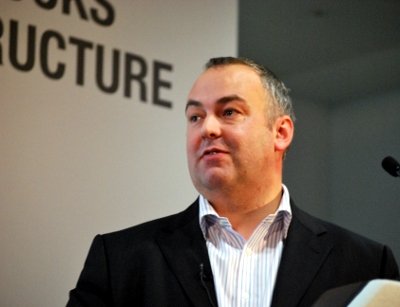
Image: Rob Coupland, COO, TeleCity Group, speaks at DatacenterDynamics London 2011