
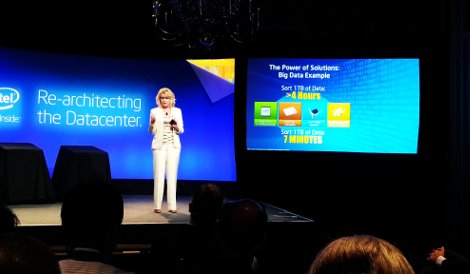

The Intel segment that sells into the data center market once again outperformed all other business segments of the chip maker in terms of revenue growth in the fourth quarter of 2013 as well as for the full year.
The Data Center Group's full-year revenue was $11.2bn, up 7% from 2012. The PC Client Group's revenue continued its downward slide, declining 4% to $33bn during the year.
The bucket Intel calls “other architecture operating segments” collectively reported $4.1bn in 2013 sales, down 7% year over year. These are segments making parts for mobile communications, netbooks, tablets, phones and embedded devices.
CEO Brian Krzanich's prepared statement on the results was upbeat. “We had a solid fourth quarter with signs of stabilization in the PC segment and financial growth from a year ago,” he said.
He touted the firm's focus on expanding into new markets through innovation. “We’ve built a strong foundation for our business by bringing innovation to the market more quickly across a wide range of computing platforms,” Krzanich said.
“For example, at CES, we demonstrated multiple devices that weren’t on our roadmap six months ago.” At this year's CES (Consumer Electronics Show) in Las Vegas, the company's focus has been on “wearables,” or smart devices users wear on their bodies, such as smart watches.
Intel demonstrated reference designs for an earpiece that understands voice commands, and a smart-phone-free smart watch, for example.
In addition to continuing cranking out more and more powerful server processors – this year it was Xeon E5-2600 v2 – the company's Data Center Group spent 2013 pushing aggressively into new data center technology markets, such as microservers and software defined networking (SDN).
Intel has also continued fleshing out its vision for Rack Scale Architecture, which does away with a traditional server chassis. Instead, individual server components, such as processors, memory cards or network interface cards (NICs), are sharing common resources in a rack and are provisioned automatically according to any particular application's requirements.
The year also saw Intel promote its relevance in the cloud infrastructure services market. Much like the marketing campaign that put the famous “Intel Inside” logo on PCs in the '90s, the company has now persuaded first Amazon Web Services, and more recently 16 other providers of cloud services to display Intel branding whenever cloud resources are underpinned by its chips.
Intel's total 2013 revenue was $52.7bn, down 1% from 2012. The company's net income for the year was $9.6bn, down 13%.
Full-year earnings per share were $1.89, down 11%.