

Intel is planning to start offering air-temperature and airflow sensors on its server processors to help increase data center energy efficiency.
The company is planning to make the technology available to server vendors sometime in 2012, senior solution architect at Intel's high-density cloud computing division Jay Vincent told IDG. The idea is to feed real-time environmental data straight from the platform into an airflow modeling software for analysis and to adjust the cooling system accordingly.
See our February interview on IT-load scheduling based on environmental data collected at the processor level with Intel data center architect Gary Howard by clicking here
Sitting inside the server, the sensors measure in real time total airflow pushed through the server and average outlet temperature. The technology does not require any physical modification of the hardware, drawing from data already available.
The characteristics are computed using new algorithms and mathematical formulas. Airflow is derived from the speed of each fan, and average outlet temperature is computed using total power the server draws and airflow.
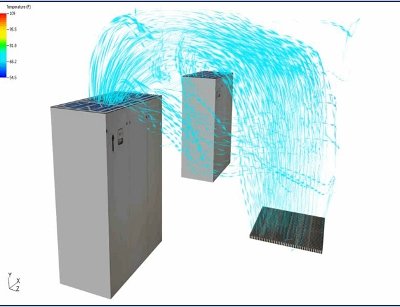
Data collected by the sensors is aggregated and evaluated by computational fluid dynamics (CFD) software to identify hot or cold spots, recirculation or bypass. Temperature and airflow are then adjusted based on the findings.
Vincent and Akhil Docca, engineering and product manager at Future Facilities, presented results of a proof-of-concept project that tested this approach at the DatacenterDynamics conference in San Francisco on 30 June. Future Facilities provided its CFD solution for the study.
The set-up involved filling a rack with servers with platform-based airflow and temperature sensors in a typical data hall, isolating it from the rest of the room. Data collected in real time included inlet air temperature, outlet air temperature, airflow and power.
One of the results was that the operators were able to increase supply air temperature from normal operating temperature by 8.4C. In the test set-up, cooling vents could be adjusted dynamically to change airflow and temperature based on sensor data.
Supply airflow was reduced as well, going from 525 cubic feet per minute (CFM) to 501 CFM. Supply flow reduction resulted in a 2.4% fan power reduction and reduction of the supply air temperature allowed for a 36% reduction of energy use by the cooling system.
"A dynamic data center cooling environment reacts to the server requirements, allowing higher ambient temperatures and lower fan speeds therefore reducing running costs without impact to IT resilience," Docca and Vincent's presentation concluded.