

The year has been interesting for Intel Corp. to say the least. Brian Krzanich, the new CEO who replaced Paul Otellini in May, is at the helm of a company whose bread-and-butter PC-processor business is increasingly under fire from a market shift toward tablets, and whose struggle to grow presence in the smartphone space (dominated by ARM Holdings’ licensees) remains a tough one.
Intel’s huge lead over others in the x86 server market seems safe, however. The company launched the second generation of its Xeon E5-2600 server-chip family, codenamed Ivy Bridge-EP, in September, and continued going with a vengeance after the low-power microserver market, where competition from ARM-based vendors is fierce.
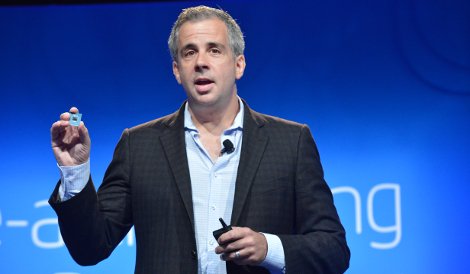
Jason Waxman, general manager of high density servers at Intel, says sales of the new Xeon servers will be faster than sales of the first-gen Ivy Bridge units, since the platform has already been validated by enterprises. In September, the company announced one of the first 64-bit low-power server System on Chips (SoCs) the market has seen and demonstrated the first physical prototype of a system based on its Rack Scale Architecture (RSA) concept, where individual server components – such as processors, network or memory cards – can be replaced individually. Components in this RSA system were interconnected by a fabric based on silicon photonics, a technology Intel considers to be crucial to success of the Rack Scale concept.
We sat down with Waxman to talk about the new Xeon line, the microserver and SoC market and RSA in detail at the Intel Developers Forum in San Francisco in September.
DatacenterDynamics FOCUS: Intel went from a 32-nanometer process technology used in the first generation of Xeon E5-2600 to a 22nm one in the latest Ivy Bridge chips. What’s the significance of that change?
Jason Waxman: Process technology just happens to continues to be one of our competencies. It’s increasingly more difficult for companies to invest in fab infrastructure and process technology, but we’ve demonstrated that it makes a big difference in terms of performance, power efficiency and, essentially, what you can integrate into the die.
We just had [E6-2500] V1, and now it’s V2. But because they’re 22nm, we have 50% more cores on the product. You can increase the cache by 50% as well. We’re able to go ahead and do it while still keeping
roughly comparable frequency and improvements in power.
DCDF: You guys have been talking a lot about customization options. How can the new Xeons be optimized for different workloads?
JW: We have a number of different performance and power points that are optimized in some cases for specific customer workloads. There are some data centers that say, “I am interested in getting more frequency out of it, and I’m willing to go trade off temperature, so I’ll find some unique way of cooling the silicon if I can get higher frequency boost out of it or more dynamic range as a result of the silicon.” so we’ll find ways to bend out CPUs that support that kind of dynamic range.
Some people are trading off reliability for some kind of other performance features that you can kind of get out of the silicon. There are a lot of parameters. If you look at the knobs that you dial, they are frequency, they are power consumption, they are temperature and they are useful life. There are other knobs you can dial but these are four of the big ones.
DCDF: Software Defined Networking has been a big theme at this year’s IDF. What SDN features does the new Xeon support?
JW: This becomes, for a number of switches, the processor that supports what we call the control plane. If you look at the architecture of switches for SDN, you’ve got the control plane, which you’d like to run Intel standard x86 code, which also, by the way, supports Network Function Virtualization. You have a platform that [can] look a lot like the profile of a standard server that’s kind of configured as a switch. You can decide how you run traffic through it. Our Fulcrum silicon that also supports Layer 2 switching. Plus, we have other functions that we add for crypto or pattern matching. All those things become elements of the platform that support SDN types of configuration.
DCDF: Has the Data Center Manager capability been changed at all with the new chips?
JW: We just have additional power states. One of the things that we did change was a bit of the power curve. One of the things you find as you go to turbo states with Ivy Bridge – and this is also impact of 22nm – is that the power and performance curve in turbo states was a bit more kind of linear and proportional. What we’ve actually been able to do is – through the use of voltage scanning, through the transistor and the move to the 22nm – we’ve been able to kind of flatten out that curve a little bit, so you’re getting more performance in turbo but not increasing necessarily the power proportionally, as you might have in the past.
DCDF: What do you expect the take-up of the 64-bit Atom SoC to be over the next couple of years?
JW: What I can tell you is that we’re seeing good interest in the new Atom C2000 for very specific applications, particularly for what we call microservers, which will be targeted for hosting types of applications and for networking applications. Also for cold-storage applications, where for example, a company like Facebook just wants as many drives as it can attach to a very light-weight node.
That’s where we see most interest right now, but things are so early, and it’s tough to predict. People will find new uses for them, and at the end of the day, I like the fact that I don’t have to predict. I want to make sure that whether they choose Xeon or they choose Atom, they’ve got the best solution coming from us, and we’ll let the forecasts lay where they may.
DCDF: Atom’s got to eventually replace some of the x86 servers for some workloads. What does Intel expect those dynamics to be like?
JW: It depends on the segment, and it also depends on how “replace” turns out. In microservers, it’s interesting, because in a lot of cases people are buying capacity and so, as an example, they may spend a million dollars on server infrastructure, and they’ll say, “Well, for that million dollars I’ll buy 500 Xeons, or I’ll buy 5,000 Atoms.” In that case, they might replace Xeons, but it maybe replacing it at more than a one-to-one type of ratio. But in networking and storage ... it’s actually replacing proprietary architectures or, in some cases, ARM-based architectures. They may shift from Xeon and some of the lightweight workloads and may scale more than one-to-one. But also ... if you looked for example at the hosting market or cold storage, a lot of those applications are actually incremental business to us, rather than replacement.
DCDF: When Rack Scale Architecture is out on the market, how will customers that buy it differ from SoC/microserver customers or from x86 customers? How do you see all the pieces fitting together?
JW: I see them kind of merging. I think, for example, Rack Scale is targeted toward customers that need a large amount of scale. They want a building block that they’re going to replicate in build-out relatively quickly. A cloud service provider might be an ideal sort of customer for Rack Scale Architecture.
Those customers may be deploying microservers today. I think in the future ... they’ll replace them with Rack Scale Architecture. And SoCs that are currently in microservers as the compute unit would still potentially be the compute unit – the compute trays that go into Rack Scale Architecture. So the underlying ingredients of the technology move forward but Rack Scale I think will replace microservers, and then you’d have general purpose dual-socket Xeons. I think a lot of those CPUs will find their way into trays that go into Rack Scale Architecture, so it might be a slightly different form factor, but those two can be applied for hyper-scale customers into the Rack Scale Architecture.
You’ll still see a lot of the standard rack-mount servers going to enterprises that may not need to buy at the massive scale that Rack Scale Architecture is designed for.
DCDF: You don’t think Rack Scale has the potential to replace rack-mount servers?
JW: Yeah, I do think it will. It’s hard for me to know exactly how much. I don’t think it’ll completely replace them, because I think that there will still be some people that will want to buy the well-defined boxes and retrofit their infrastructure with standard rack-mount stuff. But I do think that for a lot of people that buy at scale, Rack Scale will be very attractive.
I’ve been kind of surprised at some of the segments in the industry that have shown interest in deploying Rack Scale Architecture sooner that I didn’t think would be really interested in it. So, just goes to show that you can’t predict this sort of thing. But I definitely think that its still largely the customers that have substantial volume purchases and are deploying racks of servers that will really )(benefit from) Rack Scale.
This article first appeared in the 32nd edition of DatacenterDynamics FOCUSmagazine. Follow the link for a free subscription.