

Intel is planning to integrate its server processors with interconnection-fabric controllers, making a tighter bond between compute and storage resources.
The product that comes out of these efforts will be a culmination of multiple acquisitions the company has recently done. These include the purchase of QLogic’s InfiniBand business, the Ethernet-switch chipmaker Fulcrum and the IP and engineering team behind Cray’s fabric technology.
A fabric takes the network switch out of the storage-server interconnect equation.
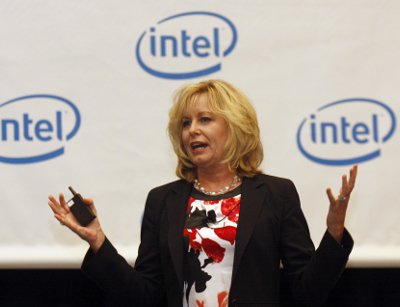
Diane Bryant, who announced the plans at the Intel Developer Forum in San Francisco on Tuesday, said such integration would provide a tremendous lead in performance and density. “We’re in a unique position to make that next leap in innovation and integration,” she said.
Intel will use interconnect expertise of the Cray team, QLogic’s InfiniBand technology and Fulcrum’s Ethernet chops to graft fabric controllers onto chips. Having both Ethernet and InfiniBand gives Intel the ability to take its fabric project in two directions – cloud and high-performance computing (HPC), respectively – Bryant said.
Intel did not reveal when it expected to have a product as a result of this project.
HPC and Cloud are two of the biggest growth areas Intel imagines for itself in the near future, according to Bryant. The third one is Big Data.
In June, Intel announced a new brand name for its HPC products and the first product under the new brand: Xeon Phi. The product was the Xeon Phi co-processor, codenamed “Knights Corner.”
The Phi technology allows the use of more than 50 processor cores in parallel for standard Intel programming and software tools.
All three of the biggest growth areas Intel has identified rely on the company’s data center business, which Bryant oversees. This is the only business Intel expects to bring as much revenue as expected in the third quarter.
Earlier this month, the company lowered its third-quarter revenue guidance, attributing the decision to weak macroeconomic climate. There is softness in the enterprise PC market, and demand in the emerging markets is slowing, while the data center business is humming away as expected, Intel said.