
Idaho National Laboratory (INL) has brought its new Teton flagship supercomputer online.
Built to model and simulate nuclear reactor designs, the 20.8 petaflops system quadruples the capacity of compute power offered by the lab.
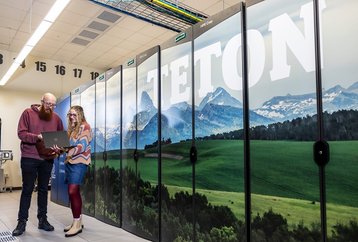
Deployed as part of the Department of Energy's Office of Nuclear Energy Nuclear Science User Facilities (NSUF) program, Teton ranked 85th on the most recent edition of the Top500 list of the world’s most powerful supercomputers.
Comprised of AMD’s 9005 ‘Turin’ CPUs, the HPE Cray EX 4000-based supercomputer was specifically designed to be one of the world’s largest CPU-only systems, as the hardware better accommodates the modeling and simulation codes of users working on nuclear reactor designs, when compared to GPUs.
Teton will continue to operate alongside the lab’s four other supercomputers, Bitterroot, Hoodoo, Wind River, and Sawtooth – the latter of which was INL’s flagship system. The new supercomputer can be accessed through NSUF and used to support the nation’s nuclear energy-related research projects.
"This represents a significant investment in the computational infrastructure needed to accelerate advanced reactor deployment," said NSUF Director Brenden Heidrich. "Teton will enable researchers to model and simulate next-generation nuclear technologies with unprecedented fidelity, dramatically reducing the time from concept to deployment for critical nuclear energy projects.”
Brandon Biggs, the Teton technical lead within NSUF’s High Performance Computing team, added: “Modeling and simulation codes are what will benefit the most. With Teton – a dedicated CPU system with just under 400,000 cores, computations that take days to turn around will be more like hours.”






Comments