
IBM has unveiled three new flash storage systems that can be co-managed by AI agents via the FlashSystem.ai platform.
According to the company, the IBM FlashSystem 5600, 7600, and 9600 offerings deliver up to 40 percent greater data efficiency compared to the previous generation, whilst also providing improved capacity and performance.
“For years, IBM has been on a mission to improve productivity, starting within IBM, using AI,” said Sam Werner, GM of IBM Storage, during a press briefing ahead of the launch. “And that's really the big thing we're bringing you here today, which is that AI is now coming to our storage to help improve the productivity of our clients who leverage our storage.”
The compact IBM FlashSystem 5600 provides up to 2.5PB of capacity and up to 2.6 million IOPS in a single 1U system, making it best suited for space-constrained environments such as Edge locations, remote offices, or smaller data centers.
Designed to handle large virtualized environments, analytics platforms, and consolidated applications, the IBM FlashSystem 7600 has been developed for organizations in need of high performance and scalability, providing up to 7.2PB of capacity in a single 2U system and up to 4.3 million IOPS.
Finally, the IBM FlashSystem 9600 provides up to 11.8PB of capacity in a single 2U system, with up to 6.3 million IOPS, and is built for enterprises running mission-critical operations that demand extreme performance and massive scalability.
IBM said the FlashSystem 9600 reduces operational cost by as much as 57 percent via AI and consolidation compared to the previous generation, with the newly unveiled solutions reducing the required storage footprint by 30 – 75 percent, depending on the model deployed, its placement, and consolidation.
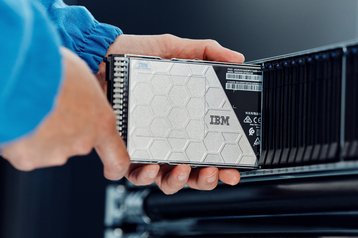
The 5600, 7600, and 9600 systems all contain IBM’s fifth-generation FlashCore Module, a drive containing up to 105TB of capacity that enables FlashSystem models to detect ransomware and anomalies rapidly without impacting system performance, while claiming to keep false positives under one percent.
All three storage systems can be co-managed by IBM’s FlashSystem.ai offering, an AI model trained on “tens of billions of data points” that the company says have been collected through “advanced telemetry and years of real-world operational data.”
As a result, the platform can execute thousands of automated decisions per day that previously required human oversight, IBM claimed. Furthermore, its agentic AI feature has been built to adapt to application behavior in hours and can suggest performance improvements and explain reasoning, all while incorporating administrator feedback in order to tailor its recommendations.
When running FlashSystem.ai on the latest generation of FlashSystem solutions, audit and compliance documentation time can be cut in half, IBM said.
During the same briefing, Alistair Symon, VP of storage systems development, said that although other companies are shipping higher terabyte drive flash modules, because those products are based on QLC NAND, they therefore cannot do enterprise write-intensive workloads for the read life that companies depreciate their hardware over, meaning they just get used for read-intensive applications.
“Our FlashCore Modules use QLC with proprietary IP that can perform like TLC,” Werner said. “So, what we have is the densest enterprise workload drive, because you cannot find a TLC drive that’s anywhere close to [the] 105 terabytes [that IBM is offering].”
Werner went on to state that this “unique proprietary technology” allows IBM to optimize for cost and density, providing the company with some advantage when it comes to challenges around cost currently facing other vendors.
“We're able to secure our supply, and we've got really good relationships with all of our suppliers. We build our drives, and we've been planning for that for some time,” he said. “Do we anticipate raising our prices? … from what I've seen, [the industry] has raised prices significantly. We do have some advantage within our technology, so I believe we will remain a price leader... I believe the cost to our end users will actually decline.”
IBM’s new FlashSystem portfolio will be generally available on March 6, 2026.






Comments