
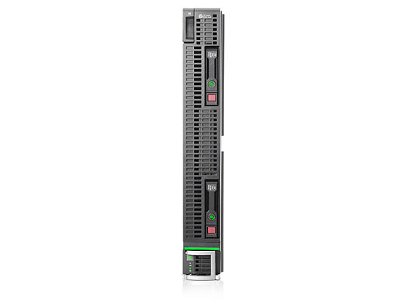

HP said it was able to consolidate the workload on three two-socket Dell blades onto one of its latest Gen8 ProLiant blades running Intel’s Xeon E5-4600 processors.
This was a result of HP’s internal calculations, the Silicon Valley IT giant said, comparing maximum virtual-machine capacity of its BL660c four-socket blade to that of three Dell PowerEdge M610 two-socket blade servers.
The BL660c won on cost as well, providing 30% savings on the combined cost of hardware, software and licenses and three years’ worth of utilities and administrator labor, according to HP.
HP put the BL660c on the market along with a four-socket Gen8 rack server DL560c this week.
John Gromala, director of product marketing for industry standard servers and software at HP, said the company was offering its first four-socket Gen8 servers as building blocks “for customers who want pervasive virtualization.”
Two-socket systems, he said, simply did not provide enough capacity for end-to-end virtualization. The four-socket systems provide large-enough pools of memory and compute to enable companies to virtualize more than the common rate of 50-80% of applications.
Compared to HP’s own previous-generation servers, the DL560 Gen8 can support virtual machines better due to a denser memory design. Its local latency is lower when idle and at maximum memory throughput when compared to HP’s DL580 G7 server running Intel Xeon E7-4800.
To boost memory in the new servers, instead of stuffing more DIMMs (dual in-line memory modules) into the system, HP increased memory of each DIMM by 60%, Gromala said.
Both new products feature HP’s ProActive Insight Architecture, a series of system management and automation tools that came out along with the first group of Gen8 servers in February.