
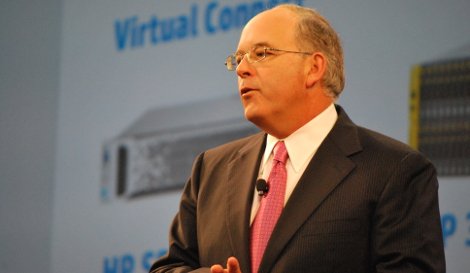

Along with reporting its second-quarter earnings, HP announced that its COO Bill Veghte was taking over the reins of the company's Enterprise Group, replacing Dave Donatelli, who will move on to “a new role focused on identifying early-stage technologies.”
Donatelli, who came to HP three years ago after a 22-year run at EMC, has led introduction of new technologies to the company's portfolio, namely Moonshot, its microserver line, and StoreOnce, a back-up and recovery storage appliance.
In his new role, Donatelli will continue to report to president and CEO Meg Whitman. His job will be to identify early-stage companies with new technologies, similar to the two aforementioned ones he brought to market.
The company said it had not made immediate plans to replace Veghte in the COO chair.
To read our recent in-depth interview with Donatelli in Issue 30 of FOCUS magazine, visit this page and sign up for free
All of HP's segments reported a decline in revenue year over year. The enterprise group, however, was one of the groups whose revenue declined the most
HP's net revenue for the quarter was US$27.6bn – 10% down year over year. Its net earnings were $1.1bn – down 32%.
The company reported $0.55 earnings per share, or 32% down from the $0.80 EPS it reported for the second quarter of 2012.
As customary, Whitman said she was optimistic in the face of macroeconomic headwinds and the long time it will take to turn the company around. “I'm encouraged with where we are,” she said in the earnings call Wednesday, adding that HP had made progress on its turnaround effort during the second quarter and attributing difficulties primarily to what she called “operational impediments,” which her turnaround efforts have been aimed at.
Among segments that need improvement, Whitman highlighted HP's hyper-scale and mainstream server businesses. The company underperformed in the second quarter in both of these markets, she said, attributing poor performance to flawed execution.
“We simply have to execute better, and we're on it,” she said. “We have to closely manage the balance between margin and share.”
Trading market share for higher margins
Whitman explained that HP was not likely to sacrifice the bottom line in the name of market share. “This quarter you saw one of our competitors Dell completely crater their earnings,” she said.
Dell made substantial market-share gains in the server space during the quarter – almost catching up to HP's share – but its earnings per share were down 71% year over year.
This maybe a good strategy for a company preparing for a private buyout (Dell is currently going through a lengthy buyout battle), but it is not what you do if you are running a publicly traded company, Whitman explained.
Keeping margins from going down has been especially hard in the mainstream-server market, where the company has faced strong competition on price. HP walked away from a number of mainstream-server deals during the quarter to protect its margin, Whitman said.
Kathie Lesjak, HP's CFO, said the only situations where HP would agree to sacrifice margin size for a sale are where it sees clear potential for a beneficial long-term relationship with the client.
The company's key hyperscale play is Moonshot, the low-cost, low-power Donatelli-led microserver line. Lesjak said weakness in sales to service providers was partially to blame for poor results in the hyperscale segment.
Revenue down across entire enterprise group
The enterprise group's overall revenue declined 10% year over year in the second quarter, operating with a 2.6% margin. Size of the decline was second only to the personal systems group's, whose revenue was down 20%.
Within the enterprise group, industry standard server sales were down 12%, business critical systems revenue was down 37%, storage was down 13% and technology services revenue was down 3%. The only part of the enterprise group that did not report a decline in revenue was networking, whose sales were up 1%.
In addition to Moonshot and the hyperscale market, HP has placed a lot of chips on the converged-infrastructure play.
“Converged infrastructure is the future,” Whitman said. “We are well positioned to capitalize on the major inflections currently underway in servers, storage and networking.