
The director of the High-Performance Computing Center (HLRS) in Stuttgart, Germany, has revealed the existence of the AMD MI600 AI chip, something that has not been previously disclosed by the chipmaker.
During a discussion with journalists about the procurement processes for the successor to the center’s forthcoming system, Herder, Professor Dr. Michael Resch, said: “We are not so much interested in the MI400… We are already interested in MI500, 600.”
AMD has not yet publicly published a roadmap that acknowledges the existence of an AI chip beyond the MI500, which is currently targeted for 2027. Announced at AMD’s Advancing AI event last month, few details are currently known about the MI500 beyond its slated release date and the fact that AMD expects to include it in its next-generation AI rack.
"We are already deep in the development of our 2027 rack that will push the envelope even further on performance, efficiency, and scalability with our next-generation Verano CPUs and Instinct MI500-series GPUs," AMD CEO, Dr. Lisa Su, said during her keynote speech.
When approached for comment by DCD, AMD said: "We do not comment on unannounced products."
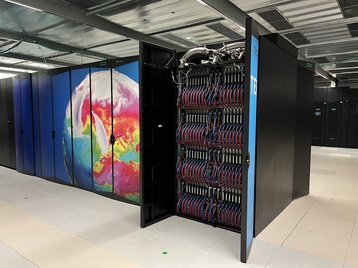
HLRS is currently home to the Hunter supercomputer, the first of two HPE supercomputers ordered by the university to take its High-Performance Computing Center (HLRS) up to exascale level.
Brought online in January 2025, the €15 million ($17.5m) system comprises 752 AMD Instinct MI300A accelerated processing units (APUs) across 188 liquid-cooled nodes. It has a theoretical peak performance of 48.1 petaflops, and each of its nodes is equipped with four HPE Slingshot high-performance interconnects.







Comments