

If there is such a thing as Silicon Valley’s favorite law firm, Fenwick & West (F&W) has to be it. The company helped Apple incorporate in 1976, took Oracle and eBay public in 1986 and 1994, respectively, and negotiated one of the world’s first software-license agreements with 19-year-old Bill Gates.
It went to battle in intellectual-property infringement disputes between Apple and Microsoft, Adobe and Macromedia, Amazon.com and Barnsandnoble.com and more recently, acted as a key legal adviser to Facebook in its IPO that commenced in May.
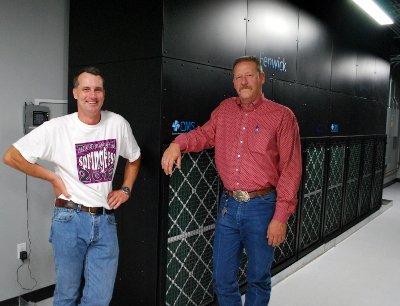
Doing the Valley’s legal work requires some data center muscle. Just recently F&W gave itself help in this area with a new facility on the first floor of the firm’s 11-year-old headquarters in Mountain View, California.
This highly energy efficient, state-of-the-art facility has been certified with the US Green Building Council’s (USGBC’s) Leadership in Energy and Environmental Design (LEED) for Commercial Interiors at the Platinum level – the highest of its kind.
The data center has been online since November 2010. Dave Reno, manager of IT services at F&W, says the company ran out of capacity at its previous data center and needed to expand. “We outgrew the space we were in,” Reno says.
Unpredictable capacity growth
Kevin Moore, the firm’s director of IT, says that while the new data center has been designed to accommodate 10% annual growth in capacity demand for up to seven years, growth overall has been unpredictable. In the last 10 years the firm’s digital storage capacity requirements alone went from 300 terabytes to 1.2 petabytes.
“We estimate [the facility to be sufficient for] five to seven years, based on previous growth,” Moore says, acknowledging that this cannot be guaranteed.
Moore has been at Fenwick & West since 1998. He oversees the company’s information security, privacy, compliance and e-discovery responses. He also assists the company in computer forensics and its own e-discovery endeavors. This is one of the key drivers for data center capacity demand growth for the law firm, Moore says. “We do a lot of litigation,” he says. “Part of litigation is e-discovery.”
E-discovery – or electronic discovery – is lawyer speak for exchanging information in digital format to be used in litigation. In basic terms, in an e-discovery process an attorney will identify a record a company has that may contain useful evidence for litigation and will place a legal hold on that. This means the company in position of the record cannot legally get rid of it. Through digital forensics, the evidence is then extracted from the record to be used in court.
IT gear housed in F&W’s data centers helps facilitate this process in addition to serving the regular enterprise IT purposes.
The Mountain View data center’s floor measures 2,000 sq ft. The company also has a ‘hot’ disaster-recovery site at a colocation data center by Raging Wire in Sacramento, California (about 120 miles northeast of Mountain View). F&W has more IT capacity deployed in smaller server rooms at its offices in San Francisco and Seattle, Washington.
What’s inside?
Ingo Lange, a contractor for F&W who helped design and currently runs the primary data center, says the facility is running at a load of 100kV, although the infrastructure has been built out to 250kV. Two 480kV utility feeds by PG&E come into the data center but only two Eaton Powerware 225kV uninterruptible power supply (UPS) systems are currently running. For reliability, they are set up to run in parallel.
Three nine-rack pods are currently deployed on the raised floor, with enough space left to accommodate one more. Each pod provides up to 75kW of critical power. While segregating hot and cold aisles, the pods are not completely contained, allowing for some air mixing in the overall environment.
IT infrastructure inside the pods consists of HP ProLiant servers, Cisco Nexus switches and storage arrays by Hitachi and EMC.
One of the biggest LEED-point scorers for the data center was its cooling system. It gets a big part of its cooling capacity through a dedicated waterside economizer on the roof.
Through the use of free cooling and by maintaining server intake air at 72F, the data center’s operators were able to reduce runtime of the chiller plant to a total of 12 hours in all of 2011 and into spring of 2012.
Custom-built CRAH
Both the dual-conversion single-pass chiller and the variable-frequency-drive-equipped Computer Room Air Handler (CRAH) were custom designed by ADC Engineers, the company that designed the entire data center.
The chiller stays in idle mode as long as outdoor air’s dew point stays at or below 61F. It is operated automatically through by custom-designed building-management system.
Another system that scored LEED points for the data center was LED lighting with automatic controls by Redwood Systems.
“The data center was used as a test bed for the Redwood lighting system,” Lange says. Because of its performance in the data center, the company outfitted a new HQ conference center with Redwood and is considering the vendor for all new construction.
This article first appeared in FOCUS magazine. To register for FOCUS digital editions, click here.