

CERN is taking the first steps to move towards a federated cloud architecture, kicking off a one-year research project with Rackspace which will investigate ways to use OpenStack to bring more compute capability to the teams searching for the Higgs boson and carrying out other scientific work using the Large Hadron Collider.
The European Organization for Nuclear Research only just added more computing capacity to its resources with its second Tier 0 (its mission-critical facility ranking) at the Wigner Research Center in Budapest, which offers 500 servers and 5.5 Petabytes of storage and 20,000 computing cores.
Wigner is planned to house 15,000 servers by the end of 2015.
One of the Large Hadron Collider’s main experiments ATLAS, however, is currently turned off for engineering and maintenance works, and once complete CERN infrastructure manager for IT Tim Bell said work will increase at CERN, with even greater amounts of data provided for teams to sift through, store and analyse.
CERN hit the 100 petabyte mark for the amount of data it had stored earlier this year.
Bell said the nature of experiments means the IT teams are constantly dealing with “excessive peaks” where the amount of data needing processing can grow.
“It is difficult to predict how much additional capacity we need because physicists can use an almost infinite amount of computing capacity,” Bell said.
He believes the federated cloud, once designed, will be a way for CERN to use public, private or hybrid cloud resources for analysis and simulation in the first instance.
“Simulation is easy to put in the Cloud, it has high CPU needs and low network I/O and low storage requirements, so that will be the first wave of apps we will look to put in the Cloud,” Bell said.
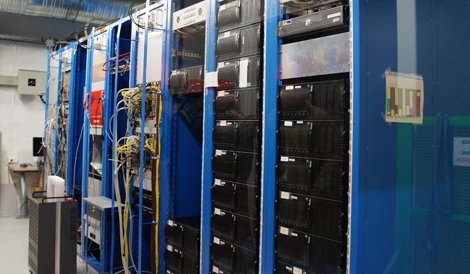
CERN is no stranger to OpenStack. Bell said it is already using the shutdown of ATLAS to set up an OpenStack installation in a 1,000 strong server farm that sits alongside the experiment.
This server farm which carries out the first stage of filtering for ATLAS collision data.
“This filters information at a Petabyte per second down to reasonable volumes, but while we are doing the upgrade of ATLAS this has been set up as OpenStack farms which are used as a resource for physicists,” Bell said.
Other research facilities providing remote resources for computing to CERN under its Tier infrastructure are also using OpenStack.
“We are now looking for ways that we can link these clouds together to use as public resources,” Bell said.
Wigner will also host an OpenStack cloud in future for analysis and simulation – at present it carries out the core requirements from CERN for data processing.
Partnering and federation
The Rackspace partnership will see the founder of OpenStack work with CERN over a one-year period to produce a reference architecture and operational mode for the federated cloud initiative.
Speaking to FOCUS magazine earlier this year Bob Jones, the head of CERN OpenLab - the project which guides commercial relationships - said one of the difficulties with using public and other cloud services at CERN is the fairness of commercial relationships.
A federated cloud leaves it open to many suppliers.
“Given the scale and style of the different services we will require for this, we don’t believe there is a single company at the moment that can offer us all the elements we need,” Jones said.
“It is also difficult to imagine in any procurement process that large public organizations will procure from a single source.
“What we will need to do is build a new market and we think this could serve the whole public sector, initially in Europe but there is no reason why this could not go further.”