

While compressors are not on their way out of the data center mechanical infrastructure, their role is much smaller in design discussions today than it has traditionally been.
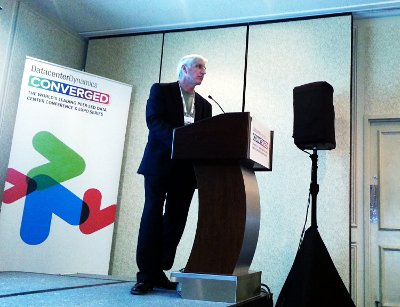
Brian George, principal at Corgan Associates, an architecture and interior-design firm, blames economization. George delivered a keynote presentation on trends in data center design at Tuesday’s DatacenterDynamics Converged conference in Dallas.
Traditionally, the conversation about data center cooling design started with the subject of compressors, George said. Today, that conversation starts with economization, compressors being a secondary concern, supplementing whatever economization technology is being used.
Improvements in air-cooled chillers and economization have “eroded the role of the compressor,” he said. That has meant a reduction in the importance of the compressor’s efficiency as well.
Some companies have also been “flirting” with the idea of eliminating the compressor altogether. While far from commonplace, “everybody is approaching that end of the scale.”
It does not mean the water-cooled chiller is on its way out, however. “This isn’t going to kill the water-cooled chiller, but it has eroded its popularity in a significant way,” George said.
This is a big trend in data center design, but there are other significant ones.
Variable Frequency Drives (VFDs) on fans and compressors are no longer optional, and neither are Power Usage Effectiveness (PUE) rates above 1.5. Both are now expected, George said.
While power density requirements have generally gone up, they have not gone up as dramatically as it has been predicted over the past couple of years. In George’s opinion, those predictions were pushed especially hard by some companies selling specialized cooling solutions.
Watts per rack have gone up more than watts per square foot. That has been driven on one hand by virtualization and on the other by data-intensive applications, such as oil-exploration, George said.
There are fewer and fewer legacy applications running on dedicated servers. Instead, business software is running on virtualized machines, which means the hardware underneath can be more uniform.
That, in turn, means data center operators can pack more servers into a rack.
Applications that process a lot of data require compute capacity to be placed as close to arrays storing massive amounts of data as possible to reduce latency, which also drives higher rack densities.