

Part 2 of a four-part special on the year’s M&A activity. Read Part 1 on M&A in colocation here.
A number of acquisitions this year have been telling about the directions of the data center hardware space. AMD bought SeaMicro for its fabric interconnect technology, and Intel bought QLogic’s InfiniBand business. In storage, IBM bought Texas Memory Systems (TMS) and EMC acquired XtremIO, both deals aimed at gaining a stronger foothold in the growing enterprise market for Flash-based storage arrays.
Following AMD’s US$334m SeaMicro buy, the chip maker was quick to point out that it would not become a server OEM and that the transaction was designed to give AMD’s OEM partners an opportunity to bring to market platforms based on SeaMicro’s fabric technology that connects many processors, memory, storage and IO into powerful systems. Still, in early September, AMD announced launch of the latest SeaMicro server based on the fabric tech.
Speaking of fabrics, early in the year Intel announced the acquisition of QLogic’s InfiniBand business for $125m. For Intel, this deal was about getting more of its processors into networking equipment running in high-performance computing (HPC) data centers.
The move enhanced Intel’s networking portfolio and gave it scalable HPC-fabric technology. Intel says it wants to reach ExaFLOP/s performance by 2018, and InfiniBand is part of that recipe. According to Intel, ExaFLOP/s is one-hundred times the power of today’s fastest supercomputer.
The Flash-storage race
Much more immediate than Intel’s supercomputer goals for 2018 are the leaps and bounds being made in the enterprise SSD market. IBM’s and EMC’s splurging on Flash memory companies this year is a strong indication of rapid growth in this space.
Progress of the performance arms race between vendors has been inhibited by the bottleneck that is storage IO, and both these deals are about addressing this issue.
“We’re talking about pretty extreme IOPS,” says Brian Marshall, senior managing director at ISI Group, a research and trading company. Both TMS and XtremIO are Flash array vendors that eliminate the storage IO bottleneck.
Traditional hard drives slowed the performance of the entire architecture because of the slow IOPS of spinning disk. Because Flash does a lot better in this department, there is an explosion in its adoption by the data center, Marshall says.
It started with EMC offering customers part-Flash arrays in 2008. NetApp followed, offering Flash cache and then Fusion-io started selling PCIE cards with Flash and controller technology. The latest in this trend is the all-Flash array, well suited for applications such as databases and online transaction processing. “In my opinion, it’s kind of the most elegant architecture for adopting Flash in the enterprise,” Marshall says.
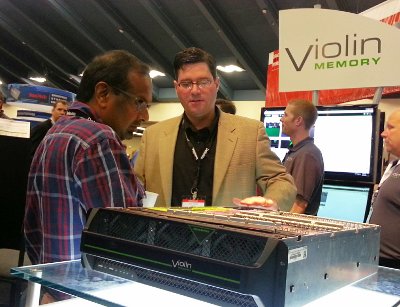
The company with the biggest footprint in this space is Violin Memory, but that doesn’t mean TMS and XtremIO are lightweights. By end of 2011, total investment raised by XtremIO was $25m. In May of this year, EMC shelled out $430m to get its hands on the “pre-revenue” Israeli startup’s technology.
TMS has been in the SSD game since its founding in the late 1970s. “They’ve done a good job of coming to market and ramping up,” Marshall says about the Texas firm. “That success has not gone unnoticed.”
For IBM, this is a fast-track ticket to the solid-state storage market for enterprises, as it would take a long time to build a product for this space from scratch, Marshall says. TMS was already an established player with a product and with customers.
IBM is likely to try to put its Global Parallel File System (GPFS) on top of TMS’s RamSan Flash array, Marshall says. GPFS is IBM’s enterprise file-management platform. IBM is pushing this clustered file system for big-data analytics, structured or unstructured data, or storage and quick forwarding of large amounts of file-based data. It clusters multiple file servers and storage controllers into a single file server solution.
While it is safe to assume TMS’s business will expand rapidly, Marshall does not expect this deal to have any radical impact on the market. He says it will be interesting to see how IBM’s relationship with Violin develops. The two have been pushing GPFS on top of Violin’s Flash memory arrays, but the relationship may change now that TMS is part of IBM.
For EMC, buying XtremIO was a way to add yet another piece to the collection of Flash products the company has been compiling. “EMC is trying to become what I refer to as the Baskin-Robbins of Flash,” Marshall says [Baskin-Robbins is an international chain of ice cream shops, where you can buy more kinds of ice cream than you ever knew existed].
“Essentially, they want to supply all flavors of Flash to the enterprise,” Marshall says about EMC’s plans. “Will they have the best-tasting ice cream? Probably not, but they will be the company to sell the most of it.”
Analysts expect the SSD market to grow beyond 2012. IDC estimated this market reached $5bn in 2011 and saw no reason to believe the upward trend would discontinue. The OEM majors are ready for action and all eyes are on the firms with worthy enterprise-grade SSD technology that’s ready to go.
This article was originally published in the DatacenterDynamics FOCUS magazine, Issue 25. Subscribe for free on the DCD website.