
The University of Stuttgart has broken ground on its supercomputer data center in Germany.
The facility, which will be part of the High-Performance Computing Center of the University of Stuttgart (HLRS), has been dubbed HLRS III. It is one of the three supercomputing centers within Germany's Gauss Centre for Supercomputing (GCS).
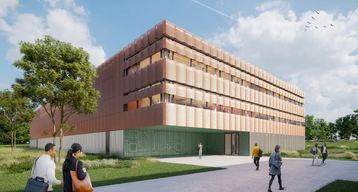
The new data center building will span 7,000 sqm (75,347 sq ft), and will be home to two supercomputers: the next "flagship" supercomputer dubbed Herder, and an AI-optimized computer development with HammerHAI.
Details about the upcoming supercomputers are sparse, but Herder will have a performance of "several hundred petaflops," and will be installed in 2027.
The University of Stuttgart's most recent supercomputer, Hunter, came online in January 2025 and has a theoretical peak performance of 48.1 petaflops.
Speaking on the project, Science Minister Petra Olschowski said: “With the laying of the foundation stone today, we are sending a clear signal: Baden-Württemberg is leading the way in supercomputing.
"The HLRS III building will significantly strengthen our cutting-edge research. It provides the scientists in the state with precisely the foundation they need for high-performance computing and the AI applications of tomorrow. We are consciously investing here at the highest level in technological sovereignty because we want to shape the future of Baden-Württemberg ourselves and not leave it to others.”
The facility will feature photovoltaic systems on the roof and facade, which will be used to help power the data center, and waste heat from the supercomputer will be fed into the campus's heating network.
The state of Baden-Württemberg is providing €138.5 million ($162.73m) in the new building. The federal government is contributing a further €40.1m ($47.11m) to the structural and technical building infrastructure of HLRS III. The total project cost amounts to €178.6m ($209.84m).






Comments