
Google’s VP and GM of AI and infrastructure, Amin Vahdat, said demand for the company’s TPUs is so oversubscribed that the company is having to turn customers away.
Speaking on a panel at Andreessen Horowitz (a16z) Runtime event in Utah last week, Vahdat said that Google currently has seven generations of its TPU hardware in production and that its “seven and eight-year-old TPUs have 100 percent utilization.”
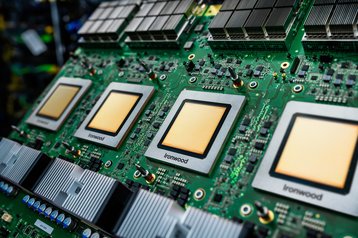
Google's TPUs - or Tensor Processing Units - are chips optimized for AI workloads. The latest generation, dubbed Ironwood, was unveiled in April of this year.
“This tells me that demand is tremendous,” he said in response to a question about the demand signals currently driving companies’ capex spend cycle. “We’re early in the cycle… certainly relative to the demand we’re seeing.”
When asked what he thinks might happen next in ‘processor land,’ Vahdat said he believes the future lies in specialization.
“A TPU for certain computations is somewhere between 10 and 100 times more efficient per watt than a CPU… and yet, we know, that there are other computations that if you built even more specialized systems for… for example, maybe serving agentic workloads, that would benefit from an even more specialized architecture.”
However, he noted that even for the best chip design teams in the world, getting specialized architecture from concept to live in production at “speed of light” is two and a half years, if you get everything right – which he cautions that very few do.
“How do you predict the future two and a half years out? I think we have to shrink that cycle, and then, when things slow down a bit, and they will, I think we’re going to have to build more specialized architectures because the power savings, the cost savings, and the space savings are too dramatic to ignore.”
Speaking more broadly about the challenges facing hyperscalers, particularly when it comes to data center build-out, Vahdat said the industry is currently limited by power, available land, permitting, and supply chain pressures.
He also expressed concern that data center supply isn’t actually going to catch up to the demand as quickly as the industry would like.
“I heard… some of the discussions of the trillions of dollars that we’re going to be spending, which I think is accurate, but I’m not sure that we’re going to be able to cash all those cheques. You have so [much money] you can’t spend it all as fast as you want. I think that’s going to extend for three, four, five years.”





Comments