

Google improved energy efficiency of its data center infrastructure in 2011, going to a trailing 12-month average Power Usage Effectiveness (PUE) of 1.14 from 1.16 reported for 2010, according to a blog post by Joe Kava, the company’s senior director of data center construction and operations.
Google’s data center team lives by the credo that says one cannot improve what one cannot measure, Kava writes.
“In the same way that you might examine your electricity bill and then tweak the thermostat, we constantly track our energy consumption and use that data to make improvements to our infrastructure. As a result, our data centers use 50% less energy than the typical data center.”
The most recent 12-month PUE number is a big improvement for the company since it first started reporting its data center efficiency metrics in 2008. Google’s first reported average PUE figure for six data centers was 1.21.
A PUE of 1.14 is very low compared to the industry average, which was 1.8 around May 2011, according to the Uptime Institute’s most recent industry survey.
One of the newest cutting-edge data centers is Project Mercury in Phoenix by eBay. It is reported to have a site average PUE of 1.35. This facility uses many industry best-practices to optimize for energy efficiency.
Kava outlined the key tenets of Google’s data center energy efficiency at the DatacenterDynamics conference in New York City earlier this month. The biggest difference in energy efficiency is achieved by using free cooling, he said.
“The biggest lever is still to use free cooling and maximize the use of free cooling,” Kava said. “Doesn’t matter how you go about it. Just use the free cooling.”
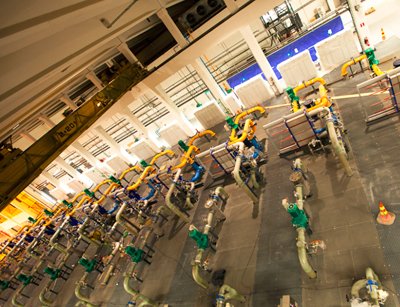
At least three Google data centers use free cooling to satisfy 100% of their needs. The first was in Belgium, where the company built a completely chiller-less facility that uses water from a nearby canal for cooling.
The second one is in Ireland. This facility is also fully cooled without the use of mechanical chillers, but uses outside air instead of water.
The last example is in Hamina, Finland, where Google’s newest data center is cooled 100% by seawater from the Bay of Finland.
One of the ways Google maximizes its use of free cooling by keeping air temperature inside computer rooms higher than standard.
Sometimes, temperature rises so high, that it exceeds occupational-safety standards and data center employees leave the computer rooms, “because it’s frankly too warm for people, and the machines do just fine,” Kava said during his keynote at the New York event.