
Google moonshot company Tapestry has partnered with the City of Rio de Janeiro to support power infrastructure at the Rio AI City project.
The project was announced in April by Rio Mayor Eduardo Paes. In May, it was confirmed that Brazilian data center firm Elea would be the main developer of the planned 1.8GW project, located in the city’s Olympic park complex.
As part of the deal, Tapestry will support the evaluation and planning of power infrastructure for AI City.
Grid managers on the project will utilize Tapestry’s GridAware tool to examine the state of the physical grid in AI City, then use its Grid Planning Tool to run grid scenarios and map out how to ramp up power capacity while maintaining near-100 percent reliability.
Tapestry is a Google X 'moonshot project' that, through the use of AI, is building what they say is the first unified model of the grid. In doing so, the company hopes to help everyone who plans, builds, operates, and manages the grid to optimize energy flow and bring more diverse sources of energy online.
Tapestry joined the project after an invitation from Eduardo Paes. The company joins Elea, Latin America’s largest electricity generation and transmission company, Axia Energia, and Light SA, Rio’s leading electrical utility, on the project.
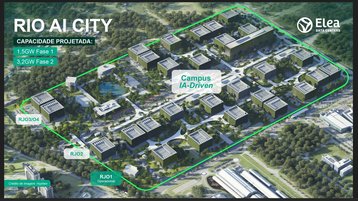
Construction work on the project has already commenced, with the second data center building on the campus, dubbed RJO2, expected to begin delivering 80MW of capacity in 2026.
This will be followed by the delivery of the RJO3 and RJO4 sites, adding a further 120MW. Further developments will take the site to 1.5GW in the first phase, which includes the existing RJ01 building, with the potential to reach up to 3.2GW in future phases.
Renders of the campus suggest that around 27 buildings could be developed at full build-out.






Comments