
South Korean chip startup FuriosaAI has partnered with Broadcom for the development of its third-generation AI accelerator, designed to support inference workloads.
According to Furiosa, the collaboration will see its Tensor Contraction Processor (TCP) architecture “evolve into a multi-die system” that is better suited for the “high-volume token requirements” of inference and agentic AI workloads.
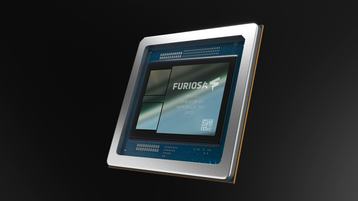
Designed to support high-bandwidth, rack-scale networking across large AI compute clusters, the third-generation accelerators are set to feature a 2nm compute die and HBM4/4E, and will integrate multiple silicon dies into a high-performance system-on-chip, while also incorporating Broadcom’s Ethernet and PCIe technologies.
In a statement, Furiosa noted that this architecture will make the chips better suited for “real-world AI workloads” and that by focusing on high-bandwidth data movement rather than thread management, the accelerators will deliver higher performance-per-watt and greater token density than “state-of-the-art GPUs.”
Sampling is scheduled to begin in the first half of 2028 to support the next decade of AI data center deployments, the startup said.
“Bringing together Broadcom’s infrastructure capabilities and Furiosa’s TCP architecture and its industry-defining software stack allows us to move beyond the chip level and deliver a comprehensive solution for the token factory era,” said Furiosa Cofounder and CEO June Paik. “Having proven the performance and efficiency of our architecture with RNGD, our second-generation chip now in mass production with TSMC, we will deliver a third-generation inference solution that offers industry-leading performance per watt for even the largest, most complex frontier AI models and agentic workloads.”
Founded in 2017 and headquartered in South Korea's capital, Seoul, to date, FuriosaAI has raised approximately $115 million across four funding rounds to support the development of its RNGD chip. Furiosa’s 180W, PCIe-based RNGD accelerators are currently in mass production, fabricated on TSMC’s 5nm process node.
In March 2024, the startup turned down an $800m acquisition offer from Meta, with the startup reportedly wanting to grow its business as an independent company instead. In January 2026, it was reported that the company was seeking to raise between $300 and $500 million in a funding round ahead of its anticipated IPO.




Comments